
Last Updated: October 31, 2026
Knowing how much you earn per hour is useful, but understanding what that hourly wage means for your total income can make budgeting and financial planning much easier. Our free hourly to salary calculator helps you convert your hourly pay into estimated weekly, biweekly, semimonthly, monthly, and annual earnings.
Whether you are comparing job offers, planning your monthly budget, or deciding whether a new position fits your financial goals, understanding your gross income is an important first step.

Enter your hourly wage, the number of hours you normally work each week, and the number of weeks you expect to work during the year. The calculator will estimate your earnings across several common pay periods.
Hourly to Salary Calculator
Convert your hourly wage into weekly, biweekly, semimonthly, monthly and annual gross income. Get your results instantly.
Enter Your Work Details
Your Estimated Gross Pay
● LIVE RESULTS$25.00 × 40 hours × 52 weeks = $52,000.00
These are estimated gross earnings before taxes and deductions. Biweekly and semimonthly amounts are annualized averages. Overtime, bonuses, commissions and additional compensation are not included. Actual paychecks may differ.
How to Use the Hourly to Salary Calculator
Using this hourly to salary calculator is simple. You only need a few details about your regular work schedule.
- Enter your hourly wage: Type the amount you earn for each hour of work. For example, enter $20 if your employer pays you $20 per hour.
- Enter your weekly working hours: Add the number of hours you normally work each week. A common full-time schedule is 40 hours.
- Enter your working weeks per year: Use 52 weeks if you expect to work throughout the year. If you expect unpaid time off or seasonal breaks, adjust this number.
- Calculate your salary: Select the Calculate button to see your estimated gross income.
- Review the results: Compare your weekly, biweekly, semimonthly, monthly, and annual earnings.

The results are estimates based on the information you provide. They do not automatically include overtime, bonuses, commissions, tips, or other additional compensation.
How Does an Hourly to Salary Calculator Work?
An hourly to salary calculator converts your hourly wage into longer income periods using your regular working schedule.
The basic calculation uses three values:
- Your hourly pay rate.
- Your average working hours per week.
- The number of weeks you expect to work each year.

For example, imagine you earn $25 per hour and work 40 hours every week for 52 weeks.
Your estimated weekly gross pay would be:
$25 × 40 = $1,000
Your estimated annual gross pay would be:
$1,000 × 52 = $52,000
This means that an employee earning $25 per hour and working 40 hours per week for 52 weeks would earn approximately $52,000 per year before taxes and other deductions.
The hourly to salary calculator performs these calculations automatically, helping you understand how your hourly rate translates into different pay periods.
Hourly to Salary Conversion Formula
You can calculate your estimated salary manually using a few straightforward formulas. Our hourly to salary calculator uses these exact formulas to estimate your gross pay for each pay period.
1. Weekly Gross Pay: Hourly Wage × Hours Worked Per Week
2. Annual Gross Pay: Hourly Wage × Hours Worked Per Week × Working Weeks Per Year
3. Biweekly Gross Pay: Annual Gross Pay ÷ 26
4. Semimonthly Gross Pay: Annual Gross Pay ÷ 24
5. Monthly Gross Pay: Annual Gross Pay ÷ 12
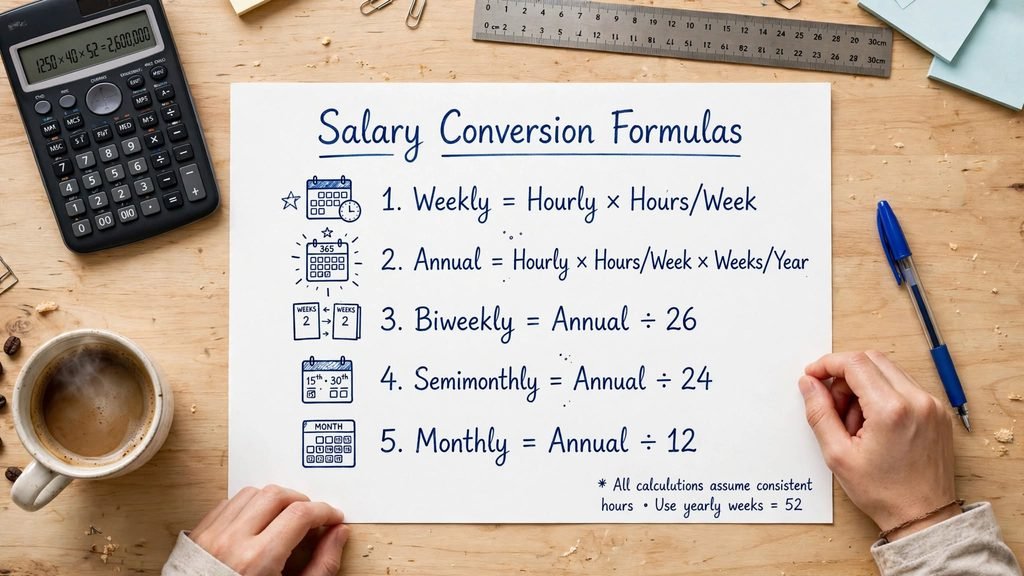
These formulas assume that your annual income is distributed across the corresponding number of pay periods. A biweekly schedule normally has 26 pay periods in a year, while a semimonthly schedule has 24.
Your actual paycheck may differ because of unpaid leave, overtime, bonuses, deductions, or an employer’s payroll practices.
Hourly to Salary Conversion Examples
The following examples show how different hourly wages translate into estimated annual earnings when an employee works 40 hours per week for 52 weeks.
| Hourly Wage | Weekly Pay | Annual Pay |
|---|---|---|
| $15 | $600 | $31,200 |
| $18 | $720 | $37,440 |
| $20 | $800 | $41,600 |
| $22 | $880 | $45,760 |
| $25 | $1,000 | $52,000 |
| $30 | $1,200 | $62,400 |
| $35 | $1,400 | $72,800 |
| $40 | $1,600 | $83,200 |
These figures represent gross earnings, not take-home pay. They also assume that the employee works the same schedule throughout the year without unpaid weeks.
Example: Earning $20 Per Hour
Suppose you receive $20 per hour and work 40 hours per week.
Your estimated earnings would be:
- Weekly: $800
- Biweekly: $1,600
- Semimonthly: $1,733.33
- Monthly average: $3,466.67
- Annual: $41,600
The monthly amount is an annual average divided by 12. It does not necessarily match every individual paycheck.
Example: Earning $30 Per Hour
Now imagine that you earn $30 per hour and work 35 hours per week for 52 weeks.
Your weekly earnings would be:
$30 × 35 = $1,050
Your estimated annual earnings would be:
$1,050 × 52 = $54,600
This example demonstrates why working hours matter. Two employees earning the same hourly wage may have different annual incomes if their weekly schedules are different.
Hourly Pay vs. Annual Salary: What Is the Difference?
Hourly pay and annual salary are two common ways employers describe compensation.
Hourly pay means you receive a specific amount for every hour you work. Your total earnings generally depend on the number of hours you are paid for during each pay period.
Annual salary usually refers to a fixed amount of gross compensation agreed upon for a year of employment. Salaried employees may receive the same regular gross paycheck even when the number of working days differs between pay periods.
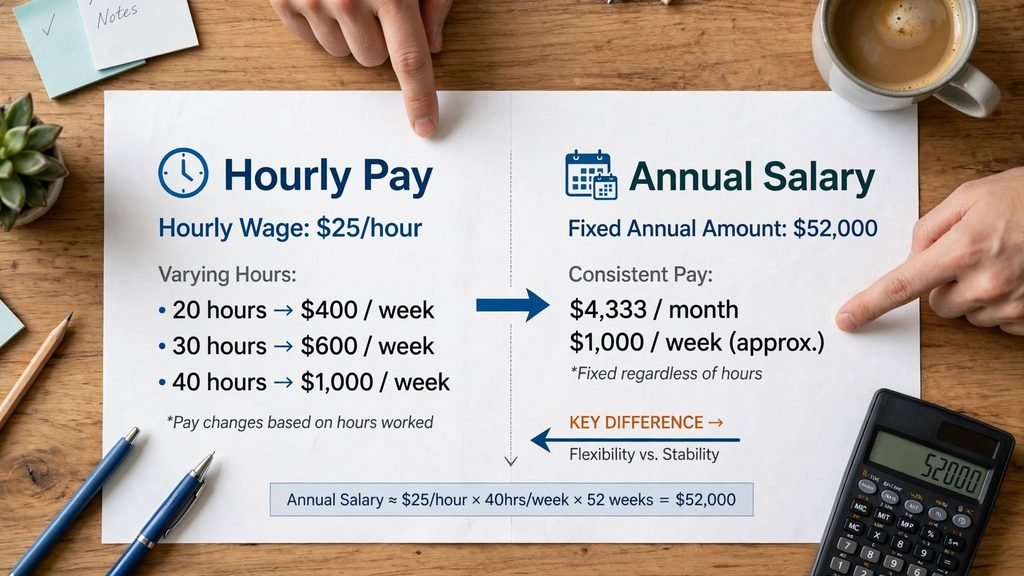
For hourly employees, working fewer hours can reduce total earnings. Working additional hours may increase pay, depending on the employment agreement and applicable overtime rules.
When comparing an hourly position with a salaried position, consider more than the advertised amount. Look at expected working hours, paid time off, benefits, schedule flexibility, and overtime eligibility.
What Is the Difference Between Biweekly and Semimonthly Pay?
Biweekly and semimonthly pay schedules may sound similar, but they are not the same.
Biweekly pay means employees receive a paycheck every two weeks. This usually results in 26 paychecks per year. Some months contain two paydays, while two months in a typical year contain three.
Semimonthly pay means employees are paid twice each month, often on fixed dates such as the 1st and 15th. This produces 24 paychecks per year.
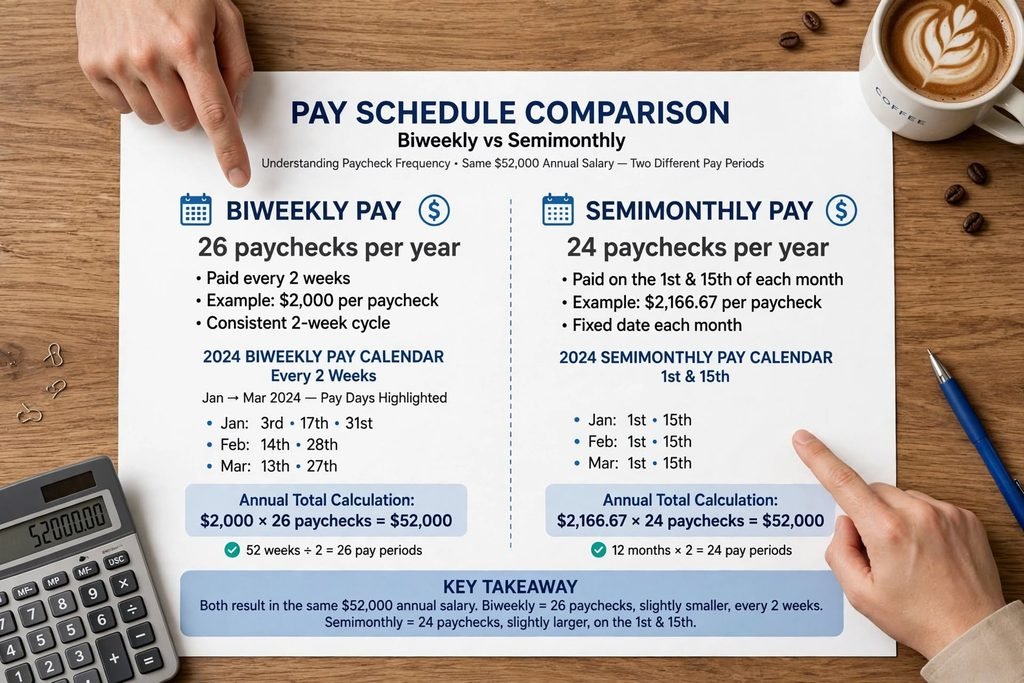
For example, an employee with an annual gross income of $52,000 would have these average amounts:
- Biweekly: $2,000 per paycheck.
- Semimonthly: $2,166.67 per paycheck.
- Monthly: $4,333.33 per month.
The annual total remains the same in this example, but the amount and timing of each paycheck differ.
Understanding your employer’s pay schedule can help you organize rent, utility bills, groceries, and other recurring expenses.
What Factors Can Affect Your Annual Income?
Your hourly wage is important, but it is not the only factor that determines your yearly earnings.
1. Weekly Working Hours
An employee working 40 hours per week will generally earn more than someone working 25 hours per week at the same hourly rate.
For example, at $20 per hour:
- 25 hours per week: $500 weekly.
- 40 hours per week: $800 weekly.
2. Unpaid Time Off
If you take unpaid leave or have periods without work, your actual annual earnings may be lower than an estimate based on 52 working weeks.
You can adjust the working-weeks field in the calculator to reflect your expected schedule.
3. Overtime Pay
Some employees may qualify for overtime compensation when they work more than 40 hours in a workweek. Under the federal Fair Labor Standards Act, covered, nonexempt employees generally must receive at least one and one-half times their regular rate for hours worked over 40 in a workweek. Certain exemptions and special rules apply.
For official information, review the U.S. Department of Labor’s Overtime Pay guidance.
This calculator does not automatically calculate overtime. If you regularly earn overtime, include your expected additional compensation separately when planning your total income.
4. Bonuses and Additional Compensation
Some employees receive bonuses, commissions, tips, or other additional payments. These amounts can increase total annual earnings but are not included in a basic hourly-to-salary conversion.
5. Changes in Your Work Schedule
A change from full-time to part-time hours, a seasonal work schedule, or a new employment arrangement can affect your annual income. Recalculate your estimate whenever your expected hours or hourly rate changes.
Gross Pay vs. Take-Home Pay
One important detail is that the result from an hourly to salary calculator represents gross pay.
Gross pay is your income before taxes and other payroll deductions.
Take-home pay, also called net pay, is the amount you actually receive after applicable taxes, insurance premiums, retirement contributions, and other deductions have been taken out.
For this reason, an annual gross income of $52,000 does not mean that you will receive $52,000 in your bank account during the year.

Your actual take-home pay depends on your circumstances, including your tax situation and employer-provided benefits.
If you want to estimate the amount you may receive after deductions, use our Take Home Pay Calculator.
You can also consult the official IRS Tax Withholding information to understand how federal income tax withholding works.
Why Should You Convert Hourly Pay to Annual Salary?
Converting your hourly wage into an annual estimate can help you make more informed financial decisions.
Compare Job Offers
Employers may advertise compensation in different ways. One position may offer an hourly wage, while another may list an annual salary. Converting both amounts to the same time period makes comparisons easier.
Plan Your Household Budget
Knowing your estimated monthly and annual gross income can help you prepare a household budget. You can use this information as a starting point before accounting for taxes and deductions.
Set Realistic Savings Goals
An annual income estimate can help you decide how much you may be able to save each month. For a more detailed savings plan, you can use the Savings Goal Calculator.
Understand the Value of Your Working Hours
Converting hourly pay into annual income gives you a clearer picture of how your time contributes to your overall earnings.
Important Limitations of This Calculator
Our hourly to salary calculator is designed for straightforward estimates. It uses the hourly wage and working schedule you enter.
Keep these limitations in mind:
- It calculates gross earnings before taxes and deductions.
- It assumes your hourly rate remains constant.
- It does not automatically add overtime, bonuses, commissions, or tips.
- It does not account for unpaid leave unless you adjust your working weeks.
- It does not determine whether you are legally entitled to overtime.
- It does not replace payroll records, an employment agreement, or professional tax advice.
For general wage information and occupational pay estimates, you can also visit the U.S. Bureau of Labor Statistics.
Final Thoughts
Understanding how hourly pay translates into annual income can make it easier to compare employment opportunities, plan household expenses, and set realistic financial goals.
Our free hourly to salary calculator provides a simple way to estimate your weekly, biweekly, semimonthly, monthly, and annual gross earnings using your hourly wage and working schedule.
Use the results as a starting point for financial planning, and remember to account for taxes, deductions, overtime, and additional compensation when estimating the amount you will actually receive.
Frequently Asked Questions
Multiply your hourly wage by the number of hours you work each week, then multiply the result by the number of weeks you work each year. For example, $20 per hour × 40 hours × 52 weeks equals $41,600 in annual gross pay.
If you work 40 hours per week for 52 weeks, earning $20 per hour equals approximately $41,600 per year before taxes and deductions.
At 40 hours per week and 52 weeks per year, $25 per hour equals approximately $52,000 in annual gross income.
If you work 40 hours per week for 52 weeks, $30 per hour equals approximately $62,400 per year before taxes and deductions.
Multiply your hourly wage by your weekly working hours and annual working weeks. Then divide the annual result by 12 to estimate your average monthly gross income.
Biweekly pay occurs every two weeks and usually produces 26 paychecks per year. Semimonthly pay occurs twice per month and produces 24 paychecks per year.
No. The calculator estimates gross income before federal taxes, state taxes, insurance, retirement contributions, and other deductions. Your take-home pay will usually be different.
No. It estimates regular earnings using your entered hourly wage and weekly hours. Overtime compensation should be calculated separately according to applicable employment rules.
Yes. Enter your actual average weekly working hours instead of 40. The calculator will estimate your earnings based on your part-time schedule.
Change the working-weeks field to reflect the number of weeks you expect to work. For example, if you expect to work 48 weeks, enter 48 instead of 52.