
Last Updated: November 06, 2026
Your Grade Point Average (GPA) is one of the most useful ways to understand your academic performance in college. Whether you are a new college student, preparing for the next semester, or reviewing your academic progress, knowing how to calculate your GPA can help you set realistic educational goals.
Our free GPA calculator makes the process easier. Enter your course grades and credit hours to estimate your grade point average using a commonly used 4.0 grading scale. You can add multiple courses, adjust credit hours, and calculate your GPA without performing the calculations manually.

This GPA calculator is designed for students who want a simple way to estimate their semester GPA. Because colleges may have different grading policies, always compare your result with the official rules provided by your institution.
GPA Calculator
Calculate your Grade Point Average using your course grades and credit hours. Enter your courses below to get your GPA.
Your GPA Result
Note: This calculator uses a common unweighted 4.0 GPA scale. Grading systems and GPA policies may vary by institution. Check your college’s official grading policy for exact results.
What Is a GPA?
GPA stands for Grade Point Average. It is a numerical representation of a student's academic performance. Many colleges and universities in the United States use a 4.0 grading scale, where letter grades are assigned numerical values.
For example, an A commonly represents 4.0 grade points, while a B represents 3.0 and a C represents 2.0. These values are then combined with the credit hours assigned to each course.
A GPA helps students, academic advisors, and educational institutions review academic progress. It may also be considered when evaluating scholarship eligibility, academic honors, graduate school applications, or other academic opportunities.
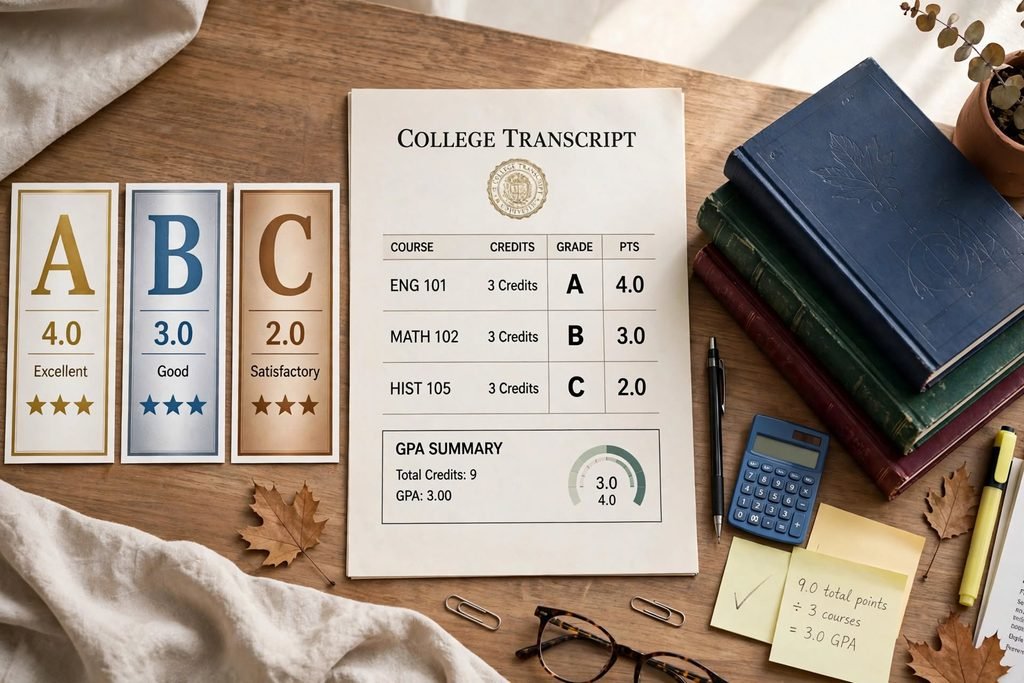
However, GPA requirements are not identical across institutions. Some schools use different grading scales, and certain courses may be excluded from GPA calculations.
How to Use Our GPA Calculator
Using this GPA calculator is straightforward. You only need your course grades and the corresponding credit hours.
Follow these steps:
- Enter Your Course Information: Add the courses you want to include in your GPA calculation.
- Select Your Letter Grade: Choose the grade you received in each course, such as A, B+, C, or F.
- Enter Credit Hours: Enter the number of credit hours assigned to each course. Check your course schedule or academic transcript if you are unsure.
- Add More Courses: Use the add-course option to include additional subjects.
- Calculate Your GPA: Select the Calculate GPA button to view your estimated grade point average.
- Review Your Results: Check your GPA, total credit hours, and total quality points.
For the most meaningful result, use the same grading scale and credit-hour information that your college uses.
Understanding the 4.0 GPA Scale
Many US colleges use a grading system that assigns numerical values to letter grades. The following table shows a commonly used 4.0 scale.
| Letter Grade | Grade Points |
|---|---|
| A+ | 4.0 |
| A | 4.0 |
| A- | 3.7 |
| B+ | 3.3 |
| B | 3.0 |
| B- | 2.7 |
| C+ | 2.3 |
| C | 2.0 |
| C- | 1.7 |
| D+ | 1.3 |
| D | 1.0 |
| D- | 0.7 |
| F | 0.0 |
These values are common examples, not a universal national standard. Some colleges assign different values to A+, D grades, or other letter grades. Your institution's official grading policy should always take priority. For another example of how letter grades are converted into grade points, visit the University of Utah's GPA calculation guide.
How to Calculate GPA Manually
You can calculate your GPA by multiplying the grade points earned in each course by the course's credit hours. These results are called quality points.
Next, add the quality points from all included courses and divide that total by the total attempted credit hours included in the calculation.
GPA Formula:
GPA = Total Quality Points ÷ Total GPA Credit Hours
This GPA calculator uses the same formula automatically when you enter your grades and credit hours. For a detailed explanation of GPA calculations, you can also consult the official guide from the University of Notre Dame.
Example of a GPA Calculation
Imagine a student completes four courses during one semester:
| Course | Grade | Grade Points | Credit Hours |
|---|---|---|---|
| English | A | 4.0 | 3 |
| Mathematics | B | 3.0 | 4 |
| Biology | B+ | 3.3 | 3 |
| History | C | 2.0 | 2 |
Calculate the quality points for each course:
- English: 4.0 × 3 = 12.0
- Mathematics: 3.0 × 4 = 12.0
- Biology: 3.3 × 3 = 9.9
- History: 2.0 × 2 = 4.0
Total Quality Points = 37.9
Total Credit Hours = 12
GPA = 37.9 ÷ 12 = 3.16
The student's estimated semester GPA is 3.16 out of 4.00.
What Is the Difference Between Semester GPA and Cumulative GPA?
A semester GPA measures academic performance during one specific semester. It includes the courses and credit hours counted during that period.
A cumulative GPA represents academic performance across multiple semesters. It combines the applicable quality points and credit hours from all included academic terms.
For example, a student may earn a 3.20 GPA in the first semester and a 3.60 GPA in the second semester. The cumulative GPA is not necessarily the simple average of these two numbers. It depends on the credit hours included in each semester.
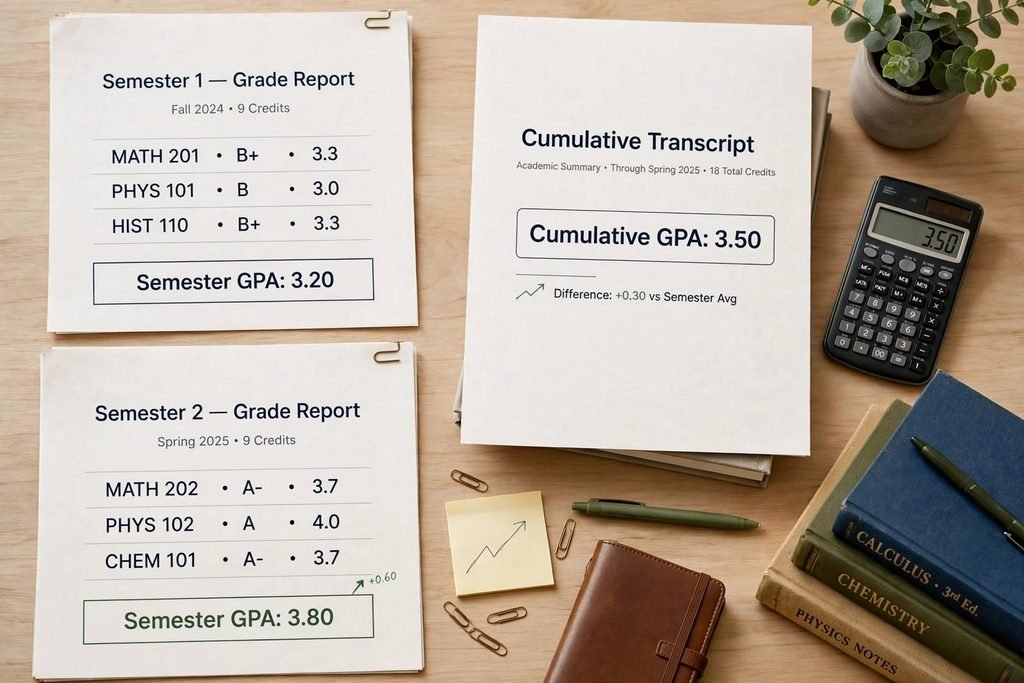
To calculate a cumulative GPA accurately, use the total quality points and total GPA credit hours from all relevant terms. You can learn more about calculating cumulative GPA by reviewing The Ohio State University's official GPA guide.
Why Are Credit Hours Important?
Credit hours represent the academic weight assigned to a course. A course with four credit hours has a greater effect on GPA than a course with one credit hour, assuming both are included in the calculation.
Consider two courses:
- Course A: A grade worth 4.0 points with 4 credit hours produces 16 quality points.
- Course B: A grade worth 2.0 points with 2 credit hours produces 4 quality points.
The calculation gives more weight to the first course because it carries more credit hours.
This is why entering the correct credit hours is essential when using a college GPA calculator.
What Is Considered a Good College GPA?
There is no single GPA that is considered good for every student or academic program. Expectations vary depending on the college, major, scholarship requirements, and educational goals.
A GPA around 3.0 is often viewed as a useful academic benchmark, while a GPA of 3.5 or higher may be competitive for certain academic opportunities. However, these are general reference points rather than universal eligibility requirements.
Students should review the specific requirements of their institutions and programs instead of relying on general GPA expectations.

More importantly, GPA should be considered alongside other aspects of academic progress, including course completion, skills development, attendance, and improvement over time.
Practical Ways to Improve Your GPA
Improving your GPA usually requires consistent study habits and realistic academic planning.
Create a Study Schedule: Organize your weekly study sessions and reserve enough time for challenging subjects.
Focus on Difficult Courses: Identify the subjects where you need additional support. Ask instructors questions, attend tutoring sessions, or join study groups.
Track Your Academic Progress: Review your grades regularly instead of waiting until the end of the semester.
Prepare Before Examinations: Divide large assignments into smaller tasks and begin preparing early.
Balance Your Course Load: Consider your available time and responsibilities before selecting courses. A manageable schedule can help you maintain consistent academic performance.
Use Your Resources: Take advantage of academic advising, tutoring services, campus libraries, and legitimate educational resources.
Important GPA Calculation Limitations
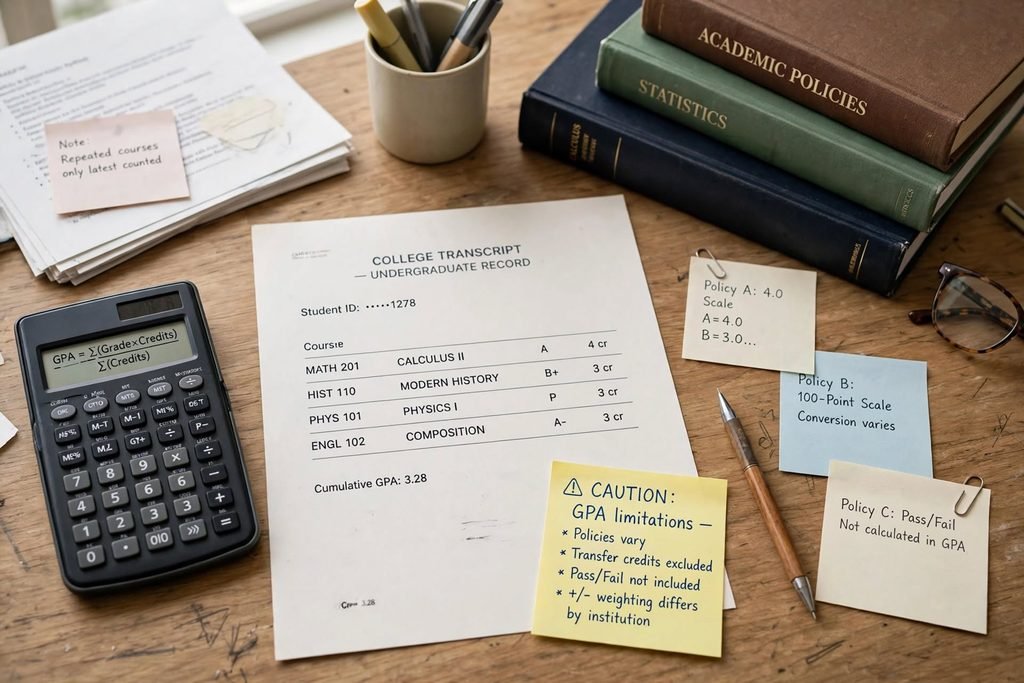
This calculator uses a simplified, commonly used 4.0 grading scale. Actual GPA calculations may differ between colleges and universities.
Some institutions exclude pass/fail courses, withdrawals, incomplete grades, or other special course statuses. Repeated courses may also be treated differently depending on institutional policies.
The calculator does not automatically account for weighted high school GPA, honors courses, Advanced Placement courses, transfer credits, or institution-specific grade replacement policies.
It is intended as an educational planning tool, not an official academic record. Always consult your registrar or academic advisor when you need an official GPA calculation.
Related Education Calculators and Guides
AffordablyUSA provides practical educational tools and guides to help students organize their academic and education-related expenses.
Explore these related resources:
- Final Grade Calculator: Estimate the score you need on your final exam to achieve your desired course grade.
- College Cost Calculator: Estimate tuition, housing, textbooks, transportation, meals, and other college expenses.
- US College Grading System: Understand letter grades, GPA values, and academic credit hours.
- How to Save Money on College Textbooks: Explore practical ways to reduce textbook expenses.
- Community College vs. Four-Year University: Compare common education costs and program options.
- How to Reduce College Expenses Without Student Loans: Discover practical ways to manage education expenses.
- Free Educational Resources for College Students: Find useful learning platforms and academic resources.
Final Thoughts
Understanding your GPA can help you evaluate your academic performance and make better educational plans. Our free GPA calculator simplifies the process by allowing you to enter course grades and credit hours and estimate your grade point average using a common 4.0 scale.
Use the results as a helpful reference when reviewing your semester performance and setting future academic goals. For official records, always follow your college's grading and GPA calculation policies.
Frequently Asked Questions
Multiply each course's grade points by its credit hours. Add all quality points and divide the result by the total GPA credit hours.
A 3.0 GPA is a useful academic benchmark at many institutions, but what is considered good depends on your college, major, and academic goals.
Yes. Courses with more credit hours generally have a greater effect on your GPA because their grade points receive more weight.
Semester GPA measures performance during one term, while cumulative GPA represents performance across multiple academic terms.
Yes. On the grading scale used by this calculator, an F is assigned 0.0 grade points. Its credit hours are included in the calculation.
It provides an estimate using a common 4.0 scale. Your college may use different grade values or rules for excluded and repeated courses. Always check your institution's official policy.