
Last Updated: November 01, 2026
Installing solar panels can help homeowners reduce the amount of electricity they purchase from their utility. However, the financial benefits depend on several factors, including household electricity consumption, local electricity prices, solar production, installation costs, and how the utility compensates homeowners for excess electricity sent to the grid.
Our solar savings calculator helps you estimate the potential financial benefits of a residential solar energy system. By entering your household energy use, expected solar production, electricity rates, installation cost, and other relevant expenses, you can estimate annual savings and how long it may take to recover your initial investment.

Whether you are comparing solar installation quotes or deciding whether solar energy could fit your household budget, this calculator provides a useful starting point.
Solar Savings Calculator
Estimate potential solar savings, upfront cost, simple payback, and long-term financial benefits.
Your Solar System Details
Estimated yearly electricity savings and export credits, minus maintenance
Direct Solar Use = Lower of Home Usage or Solar Production × Self-Consumption Rate
Annual Net Benefit = Direct-Use Savings + Export Credits − Annual Maintenance
Simple Payback = Net Upfront Cost ÷ Annual Net Benefit
What Is a Solar Savings Calculator?
A solar savings calculator estimates how much money a household could save by generating electricity with solar panels instead of purchasing all its electricity from the utility.
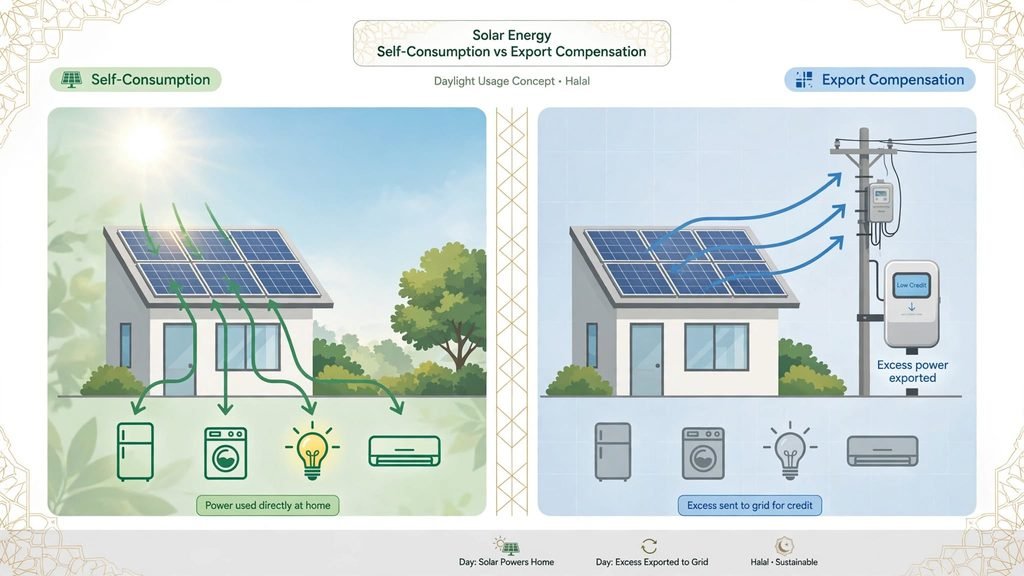
A solar installation can provide financial value in two main ways. First, electricity generated and consumed directly by your household can reduce the amount of electricity you need to buy. Second, excess electricity exported to the grid may earn a credit or payment, depending on your utility’s rules and your electricity plan.

The value of exported electricity is not always equal to the retail electricity rate. Some utilities offer net metering, while others use different export compensation arrangements. Therefore, a useful solar savings estimate should distinguish between electricity consumed at home and electricity sent back to the grid.
Our solar savings calculator considers these differences and estimates potential savings based on the information you provide.
How to Use the Solar Savings Calculator
For a useful estimate, gather your latest electricity bill and, if available, the expected production and installation quote for your proposed solar system.
1. Enter Your Annual Household Electricity Use
Find your electricity consumption in kilowatt-hours (kWh) on your utility bills. If you have 12 monthly bills, add their kWh figures to calculate annual usage.
For example, if your household uses 900 kWh per month on average, annual consumption would be approximately 10,800 kWh.
Using annual consumption is helpful because electricity use often changes with the seasons. Air conditioning, heating, and other household activities may cause significant differences between summer and winter bills.
2. Enter Expected Annual Solar Production
Enter the estimated amount of electricity your solar system is expected to generate in one year.
If you already have an installation quote, the installer may provide an annual production estimate. You can also use the PVWatts Calculator to develop a preliminary estimate using your location and proposed system characteristics.
Solar production varies according to sunlight, roof direction, tilt, shading, system design, weather, and equipment performance. Treat the result as an estimate rather than a guarantee.
3. Estimate Your Direct Solar Self-Consumption
Self-consumption is the portion of solar electricity that your household uses directly rather than exporting to the utility grid.
For example, a household might use 60% of its solar production directly and export the remaining 40%. Your actual percentage depends on when your panels generate electricity and when your home needs power.
Homes with daytime electricity use may consume a larger share of their solar production directly. A battery or changes in appliance schedules may also affect self-consumption, although a battery introduces additional costs and losses.
If you do not know your self-consumption percentage, use a reasonable preliminary assumption and test several values to see how the results change.
4. Enter Your Electricity Rate
Your electricity rate is the price you pay for each kilowatt-hour purchased from the utility.
For example, a rate of 16 cents per kWh should be entered as 16 when the calculator requests cents.
Check your electricity bill for the applicable energy rate. If your plan uses time-of-use pricing or multiple rate tiers, a single average rate may simplify the calculation but cannot represent every billing detail.
5. Enter the Export Compensation Rate
If your utility credits or pays you for electricity exported to the grid, enter the applicable compensation rate.
This rate may be lower than the retail price you pay for electricity. Some billing arrangements use net metering or other credit structures, so review your utility’s specific rules before entering a value.
If you do not receive export compensation, enter zero. The calculator will then estimate no financial benefit from exported electricity.
6. Enter the Installation Cost and Applicable Incentives
Enter the quoted installed cost of the solar system before incentives. Then enter any incentives or discounts that you have confirmed apply to your project.
The calculator subtracts the incentive amount you enter from the installation cost to estimate the net upfront cost. Incentive eligibility, timing, and requirements vary, so do not assume that a particular credit or rebate will be available without checking the current rules.
7. Include Annual Maintenance Costs
Solar systems may require occasional inspection, cleaning in some conditions, inverter replacement, or other maintenance. Enter an estimated annual amount to account for these costs.
Actual maintenance expenses vary by system design, equipment, location, and warranty coverage.
After entering your details, review the estimated annual savings, net installation cost, simple payback period, and illustrative long-term savings.
How Solar Savings Are Calculated
In our solar savings calculator, solar savings depend on how much solar electricity your home uses, how much excess electricity it exports, and the applicable prices.
The calculator uses the following simplified method.
Directly Used Solar Energy is estimated from annual solar production and your self-consumption percentage, limited to your household’s annual electricity use.
Exported Solar Energy is the remaining solar production after direct household use.
Value of Direct Solar Use is the amount of solar electricity consumed at home multiplied by your retail electricity rate.
Export Credit is exported electricity multiplied by the export compensation rate you enter.
The estimated annual net benefit is:
Annual Net Solar Benefit = Direct-Use Savings + Export Credits − Annual Maintenance
The estimated simple payback period is:
Payback Period = Net Upfront System Cost ÷ Annual Net Solar Benefit
This payback formula is meaningful only when the annual net benefit is positive. If the estimated annual benefit is zero or negative, the calculator cannot provide a finite simple payback period under those assumptions.
Example of Potential Solar Savings
Suppose a household has the following estimates:
- Annual household electricity use: 10,800 kWh
- Annual solar production: 8,000 kWh
- Direct solar self-consumption: 60%
- Retail electricity rate: $0.16 per kWh
- Export compensation rate: $0.05 per kWh
- Installed solar cost: $18,000
- Applicable incentives entered: $0
- Estimated annual maintenance: $150
In this example, the system produces 8,000 kWh annually. The household uses 4,800 kWh directly and exports the remaining 3,200 kWh.
Direct-use savings are estimated at $768 per year. Export credits are estimated at $160 per year. After subtracting $150 in annual maintenance, the estimated annual net benefit is $778.
The simple payback estimate is:
$18,000 ÷ $778 = approximately 23.1 years.
This example is illustrative, not a prediction for a particular home. Actual results could be substantially different depending on the system, utility rules, and household energy patterns.
What Affects Solar Panel Savings?
Several factors affect the estimate produced by the solar savings calculator, including sunlight, roof conditions, prices and costs.

Local Sunlight and Weather
Solar panels generally produce more electricity when sunlight is abundant, but temperature, cloud cover, shading, and seasonal changes affect output.
Two homes with identical systems can therefore have different annual production. A location-based estimate is more useful than assuming every kilowatt of installed solar capacity produces the same amount of electricity everywhere.
Roof Direction, Tilt, and Shading
The roof’s orientation, slope, and surrounding trees or buildings can affect how much sunlight reaches the panels. Shading and system losses may reduce production.
A professional site assessment can help identify potential obstacles before installation.


Electricity Prices
The higher the price of electricity that you avoid buying, the greater the potential value of each kWh used directly from your solar system. You can test different rates in the solar savings calculator to see how electricity prices affect payback.
However, changes in utility rates are uncertain. The calculator assumes the rates you enter remain constant in its simple estimate.
Self-Consumption and Export Compensation
Using solar electricity directly can provide a different financial benefit from exporting it to the grid. If export credits are low, using more solar electricity during daylight hours may improve the value of the system, depending on household needs and any additional equipment costs.

Installation Cost and Maintenance
A lower installed cost generally improves the simple payback estimate when all other assumptions remain the same. Maintenance expenses, equipment replacement, and other costs can reduce long-term financial benefits.
Compare multiple written installation quotes and check what each quote includes before deciding.
How to Evaluate a Solar Installation Quote
A useful comparison should include more than the total price. Before comparing, enter each quote’s details into the solar savings calculator to compare system capacity and production estimates side by side.
Review the proposed system capacity, estimated annual electricity production, equipment specifications, warranties, installation scope, and expected maintenance requirements.
Ask whether the quoted production estimate accounts for shading and system losses. Also confirm whether permits, electrical upgrades, roof work, monitoring equipment, or battery storage are included in the quoted amount.
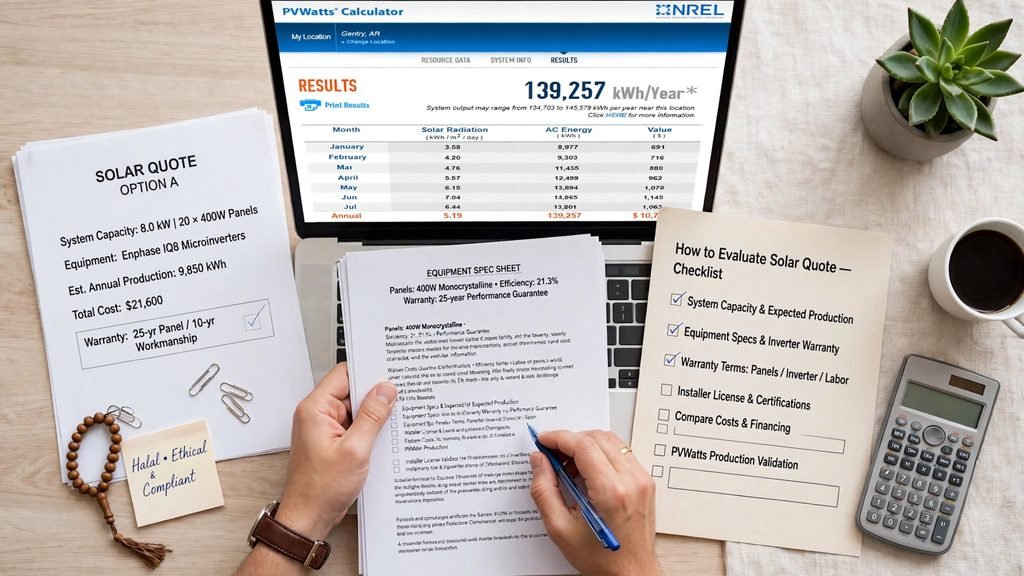
For a preliminary production estimate, use PVWatts. For more detailed photovoltaic system modeling, the System Advisor Model (SAM) provides additional modeling capabilities.
Use the Electricity Cost Calculator to estimate your current energy charges and the Appliance Energy Cost Calculator to explore the running costs of individual appliances.
Understanding Payback Period and Long-Term Savings
In the solar savings calculator, the simple payback period estimates how long it takes for accumulated annual net benefits to equal the net upfront cost.
It is a useful comparison measure, but it is not a complete financial analysis. It does not automatically account for changes in electricity prices, declining solar production, financing costs, the time value of money, equipment replacement, or changing export compensation.
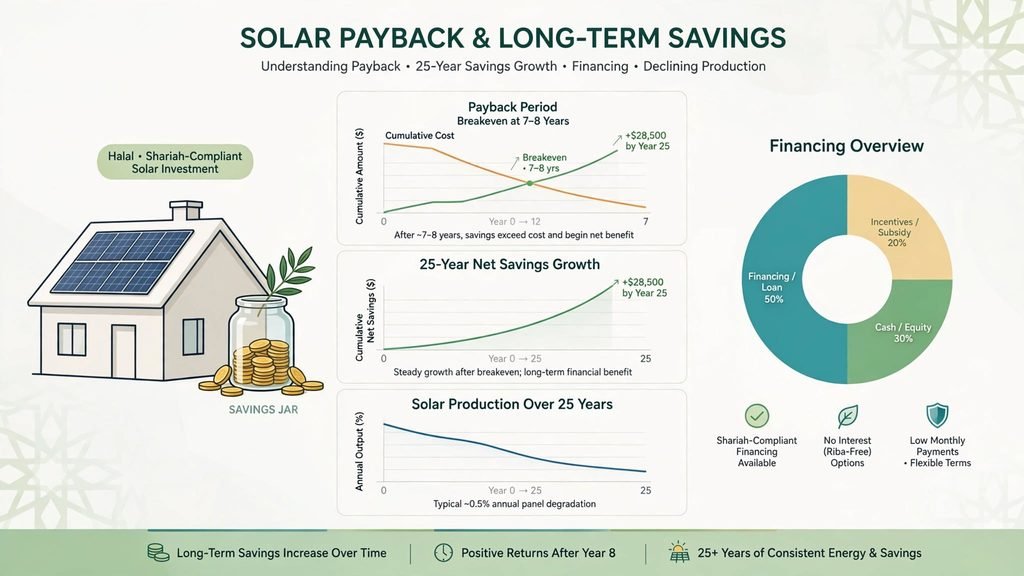
The calculator’s illustrative 25-year estimate multiplies the annual net benefit by 25 and subtracts the net upfront cost. This assumes annual net benefits remain constant throughout that period.
Actual lifetime savings may be lower or higher. Before committing to a system, consider the equipment warranty, expected service life, maintenance, inverter replacement, financing terms, and the value of any applicable incentives.
Can Solar Panels Eliminate Your Electricity Bill?
Not necessarily. Solar panels may substantially reduce the amount of electricity you buy, but your utility may still charge fixed customer fees, delivery charges, or other amounts.
The result also depends on whether your system generates enough electricity, whether your household uses it when it is produced, and how your utility handles exported energy.
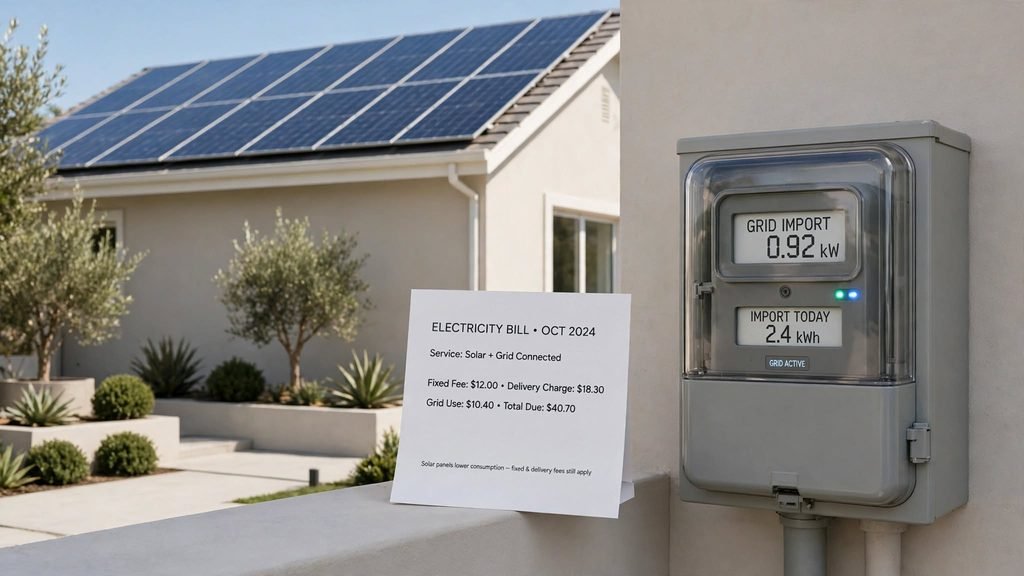
A grid-connected solar system without adequate battery storage also does not necessarily provide backup power during a grid outage. Backup capability depends on the system’s configuration and equipment.
Final Thoughts
Solar panels may help reduce household electricity expenses, but the financial outcome depends on the details of your home and proposed system.
Our solar savings calculator provides a practical first estimate of annual net benefits, simple payback, and illustrative long-term savings. Use realistic consumption and production figures, verify utility export rules, compare installation quotes, and review all applicable costs before making a decision.
For a more reliable assessment, combine this estimate with a location-specific solar production model and a detailed installation quote. The calculator is a planning aid, not a guarantee of savings or a substitute for professional system and financial advice.
Frequently Asked Questions
It estimates the financial value of solar electricity used at home and any export credits, then subtracts the annual maintenance cost you enter. It can also estimate simple payback and illustrative long-term savings using the installation cost and assumptions provided.
Savings vary by location, system size, household consumption, electricity rates, solar production, and utility export rules. Enter your own figures to estimate potential savings rather than relying on a universal monthly amount.
It is the estimated time needed for cumulative net benefits to equal the net upfront system cost. A simple payback estimate does not include every financial factor, such as financing costs or changing energy prices.
No. Solar production is the electricity generated by the panels. The financial value depends on how much you use directly, how much you export, and the rates or credits that apply.
Some utilities compensate exported electricity at a rate different from the retail rate. The exact arrangement depends on the utility, location, and applicable billing rules.
The calculator does not separately model battery capacity, charging losses, battery cost, or backup operation. If a battery is part of your project, include its cost in the installed system cost and seek a more detailed analysis of its effects.
No. Enter only incentives or discounts that you have verified apply to your project. Eligibility and program rules can change, so check official sources or consult a qualified tax professional where appropriate.
Actual savings may differ because of weather, shading, system performance, changes in electricity rates, maintenance, household energy use, and utility billing rules.
Use an installer’s production estimate or a location-based tool such as PVWatts. These estimates depend on system specifications and assumptions and are not guarantees of actual production.
No. It is an illustrative calculation that assumes annual net benefits remain constant. Actual results depend on production degradation, maintenance, equipment replacement, electricity prices, and utility policies over time.