
Last Updated: November 02, 2026
Finding an apartment is exciting, but choosing a rent payment that fits your budget is one of the most important decisions you can make. A home may look affordable at first, yet utilities, groceries, transportation, and other regular expenses can make the monthly cost much higher than expected.
Our rent affordability calculator helps you estimate how much monthly rent may fit your income, household expenses, and savings goals. Instead of relying on income alone, you can compare a general income guideline with the money you actually have available after essential expenses.

The result is a practical starting point for planning your housing budget before you begin contacting landlords or signing a lease.
Rent Affordability Calculator
Estimate a realistic monthly rent based on your income, household expenses, utilities, and savings goals.
Enter monthly amounts in US dollars. For a more practical estimate, use your usual take-home pay and realistic household expenses.
This calculator provides an estimate for planning purposes only. It does not account for every household circumstance, local rental requirements, irregular income, or unexpected expenses. Confirm actual rent, utility costs, deposits, and fees before signing a lease.
What Is a Rent Affordability Calculator?
A rent affordability calculator estimates a monthly rent amount based on your income and financial commitments. It helps you understand the difference between a rent amount that fits a general guideline and one that fits your personal budget.
A common housing affordability reference is to compare housing costs with household income. The U.S. Department of Housing and Urban Development uses a measure in which spending more than 30% of household income on housing is considered a housing cost burden. However, this is a statistical guideline, not a universal rule for every renter.

Your circumstances matter. Someone living in an expensive city may have a different budget from someone in a smaller town. A household with childcare expenses or medical bills may need a lower rent limit than a household with fewer regular costs.
The rent affordability calculator on this page considers both an income-based guideline and a budget-based estimate to help you make a more informed decision.
How to Use the Rent Affordability Calculator
Follow these steps to get a useful estimate.
1. Enter Your Gross Monthly Income
Gross income is the amount your household earns before taxes and payroll deductions. If more than one person contributes to the household budget, include the income you reasonably expect to use for shared housing costs.
Use a typical monthly amount rather than an unusually high month. If your earnings change from season to season, consider using a conservative average.


2. Enter Your Monthly Take-Home Income
Take-home income is the money you actually receive after payroll deductions. This figure is important because rent and everyday expenses must be paid with available money, not simply the amount shown on a job offer.
If your income varies, use a realistic estimate based on your recent pay history.
3. Add Your Other Monthly Expenses
Include regular costs such as groceries, transportation, healthcare, childcare, phone service, and other household needs. The more accurate these figures are, the more useful your rent estimate will be.
Do not leave out occasional but predictable expenses. You can estimate their monthly equivalent and include it in your budget.


4. Set a Monthly Savings Goal
Enter the amount you want to save each month. This helps prevent your housing budget from consuming all the money available after essential expenses.
Your savings goal should reflect your current circumstances. Even a modest, realistic amount can help you prepare for unexpected costs.
5. Include Utilities and Other Housing Costs
Add utilities that are not included in the advertised rent. Depending on the property, these may include electricity, gas, water, sewer service, or other utility charges.
You can also include renter's insurance, parking, pet fees, and other recurring housing costs. Compare these estimates with the actual terms offered by the landlord.


6. Review Your Results
The calculator displays an income-based rent guideline, a budget-based rent limit, and a suggested maximum rent based on the lower of those two figures.
Treat the result as a planning estimate. Check local rental prices, lease conditions, and the amount you want to keep available for emergencies before making a final decision.
How Much Rent Can You Afford?
There is no single rent amount that works for every household. Your affordable rent depends on income, essential expenses, location, household size, and financial priorities.
For example, imagine a household earning $5,000 in gross income and receiving $4,000 in monthly take-home pay. The household has $1,500 in other living expenses, plans to save $400, expects $180 in utilities, and budgets $70 for other housing costs.

Using a 30% gross-income guideline produces an income-based rent amount of $1,500.
The budget-based limit is calculated as follows:
$4,000 − $1,500 − $400 − $180 − $70 = $1,850
The lower of the two estimates is $1,500 per month. Adding the estimated utilities and other housing costs brings the total monthly housing budget to $1,750.
This example shows why it helps to look at both income and actual expenses. A rent amount may appear reasonable as a percentage of income but still be difficult to manage when other costs are high.
Should You Use Gross Income or Take-Home Pay?
Both figures are useful, but they serve different purposes.
Gross income is commonly used for broad housing affordability comparisons. It makes it easier to compare households using a consistent income measure.
Take-home income is more practical for a household budget because it reflects the money available after payroll deductions. Your rent, groceries, transportation, and savings must fit within this available amount.
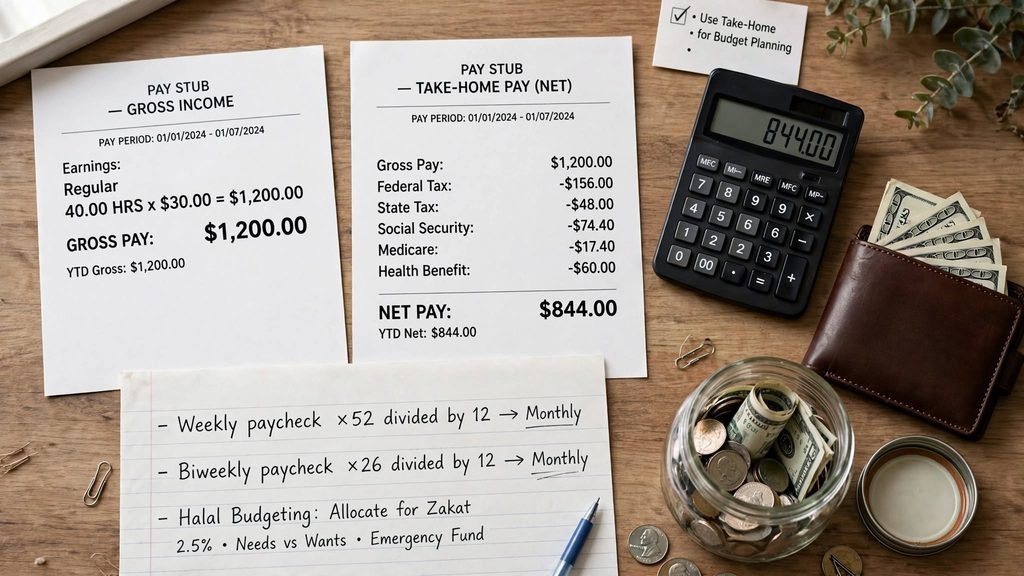
For this reason, our rent affordability calculator uses gross income for the selected percentage guideline and take-home income for its budget-based calculation.
If you are paid weekly or every two weeks, convert your income into a realistic monthly amount. For a weekly paycheck, multiplying the usual paycheck by 52 and dividing by 12 gives an estimated monthly figure. For biweekly pay, multiplying by 26 and dividing by 12 gives a monthly average.
Remember to Include the Full Cost of Renting
Advertised rent is not always the full monthly cost of living in an apartment. Some properties include certain utilities, while others require tenants to pay them separately.
Before choosing a rental, investigate:
- Electricity, gas, water, and sewer charges.
- Internet service and other household services.
- Renter's insurance, if applicable.
- Parking or pet-related charges.
- Any recurring fees stated in the lease.
- One-time moving expenses and required upfront payments.
The U.S. Census Bureau's definition of gross rent includes contract rent plus certain utility and fuel costs paid separately by the renter. This is useful when comparing housing costs, although your own budget should also reflect the expenses specific to your property.
For additional budgeting guidance, see the Consumer Financial Protection Bureau's guide to assessing spending.
What If the Rent You Want Is Too Expensive?
If the calculator suggests a lower rent than the properties you are considering, do not automatically assume that you should eliminate savings or ignore essential expenses to make the numbers work.
Instead, explore practical alternatives:
- Compare apartments in nearby neighborhoods.
- Consider a smaller unit if it meets your household's needs.
- Check whether utilities are included in the rent.
- Consider sharing a suitable home with a roommate and agreeing on a fair division of costs.
- Review discretionary spending without cutting essential needs.
- Recalculate your budget when your income or regular expenses change.
Our Roommate Rent Split Calculator can help estimate each person's share of a shared rental. If you decide to move, the Moving Cost Calculator can help you plan for relocation expenses.
You may also find our planned guides on budgeting for rent and utilities, how much income should go to rent, and ways to reduce housing costs useful once those pages are published.
Build a Housing Budget You Can Maintain
Choosing an apartment involves more than finding a landlord who accepts your application. The goal is to select housing that leaves enough room for food, transportation, healthcare, household needs, and the financial goals that matter to you.
Review your recent spending before committing to a new rent payment. Estimate utility costs, account for expenses that do not occur every month, and leave some flexibility for unexpected bills.

Revisit your rent budget whenever your household income, family circumstances, or living costs change. A calculation that works today may need adjustment after a move, a change in employment, or an increase in regular expenses.
Our rent affordability calculator provides a starting point for that process. Use it alongside actual rental quotes and a complete household budget rather than treating the result as a guarantee.
Final Thoughts
Finding affordable housing means balancing a suitable home with the rest of your household budget. A realistic estimate should account for take-home income, everyday expenses, savings, utilities, and other housing costs.
Use this rent affordability calculator to compare different rent amounts, review your results carefully, and make a decision based on your actual circumstances. The best rental budget is one that helps you meet your housing needs without losing sight of your other essential expenses and financial priorities.
Frequently Asked Questions
It estimates a rent amount using your income and monthly budget. This calculator compares a selected percentage of gross income with the amount left after your other expenses, savings goal, utilities, and additional housing costs.
A 30% housing-cost guideline is commonly used for broad comparisons, but it is not a universal rule. Your location, household expenses, income stability, and savings needs can make a different amount more suitable.
Gross income is useful for comparing your rent with a general percentage guideline. Take-home income is useful for determining whether your actual monthly budget can support the rent and other costs.
Yes. Enter estimated utilities separately if they are not included in your rent. The calculator also lets you account for other recurring housing expenses, such as parking or renter's insurance.
Use a conservative estimate based on your recent income and avoid relying on your highest-earning month. If your income is unpredictable, leave a larger buffer for essential expenses and unexpected costs.
A zero result means your entered expenses, savings goal, and other housing costs leave no money available for rent under the calculator's assumptions. Review your figures and consider more affordable housing options before committing to a lease.
No. It estimates personal budget affordability. Landlords may use their own application criteria, income verification, rental history, and other lawful screening requirements.
Include another person's income only if it is genuinely available for the shared housing budget and everyone understands their responsibilities. If you plan to share a rental, calculate each person's expected contribution separately.
Depending on the property and local requirements, you may need money for a security deposit, the first rent payment, moving services, packing materials, utility setup, and essential household items. Confirm actual charges before signing.
Use it before choosing a rental and whenever your income, expenses, household size, or housing costs change. Updating the numbers can help you see whether your current housing budget remains practical.