
Last Updated: November 03, 2026
Setting the right price for your services is one of the most important decisions you will make as a freelancer. Your rate needs to reflect the value you provide, cover your business expenses, and help you reach your income goals. Charging too little can leave you working long hours without earning enough, while setting a rate without considering your market can make it harder to attract suitable clients.

Our freelance hourly rate calculator helps you estimate a practical starting rate using your target annual income, business expenses, working schedule, billable time, and an optional financial buffer. Instead of choosing a number at random, you can use your own estimates to understand how much you may need to charge for each billable hour.
Whether you are a writer, designer, developer, consultant, virtual assistant, or another independent professional, this guide explains how to use the calculator and make more informed pricing decisions.
Freelance Hourly Rate Calculator
Estimate an hourly rate that accounts for your income goal, business expenses, and unpaid working time.
Enter your annual estimates below. Use the same 12-month period for your income goal and business expenses. Results update automatically as you change the values.
Your Estimated Freelance Rate
Estimate only. This tool does not calculate personal income taxes, self-employment taxes, or industry-specific market rates. Compare the result with your experience, service value, and client market.
What Is a Freelance Hourly Rate Calculator?
A freelance hourly rate calculator is a tool that estimates how much you should charge clients for each hour of work. It considers more than the income you want to earn because freelancers usually have business costs and spend time on tasks that cannot be billed directly to clients.
For example, you might spend time finding clients, preparing proposals, sending invoices, updating your portfolio, answering emails, and organizing business records. These activities are necessary, but clients may not pay separately for every minute you spend on them.

The freelance hourly rate calculator accounts for this difference by estimating your billable hours rather than assuming every working hour generates revenue.
The result is a planning estimate, not a guaranteed market rate. Your final price should also reflect your experience, the complexity of your services, client demand, and the value your work delivers.
How to Use the Freelance Hourly Rate Calculator
The calculator above uses six inputs to estimate a suitable hourly rate. For a useful result, enter realistic figures and keep your income goal and expenses within the same annual period.
1. Enter Your Target Annual Income
Start by deciding how much you want to earn from your freelance business over a year. This is your target income before personal taxes in this calculator.
Choose a target that reflects your financial needs, professional goals, and current stage of business. If you are starting out, you may want to compare a conservative target with a more ambitious one.
Remember that your target income is not the same as your total business revenue. Revenue must also cover the expenses required to operate your business.

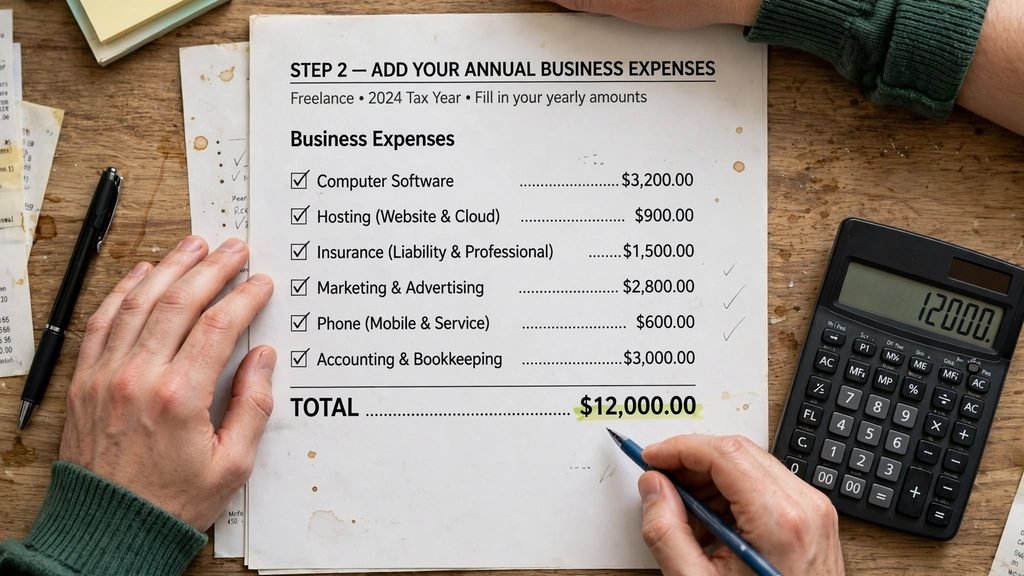
2. Add Your Annual Business Expenses
Include your expected business costs for a full year. Common examples include:
- Computer equipment and work supplies
- Design, editing, or project management software
- Website hosting and domain registration
- Professional insurance and licensing costs
- Marketing and portfolio expenses
- Business-related phone and internet costs
- Accounting, bookkeeping, and administrative services
Use reasonable estimates based on your current spending and anticipated needs. The U.S. Small Business Administration provides guidance on identifying and estimating business costs through its business planning resources.
The more accurately you estimate your expenses, the more useful your freelance hourly rate calculator result will be.
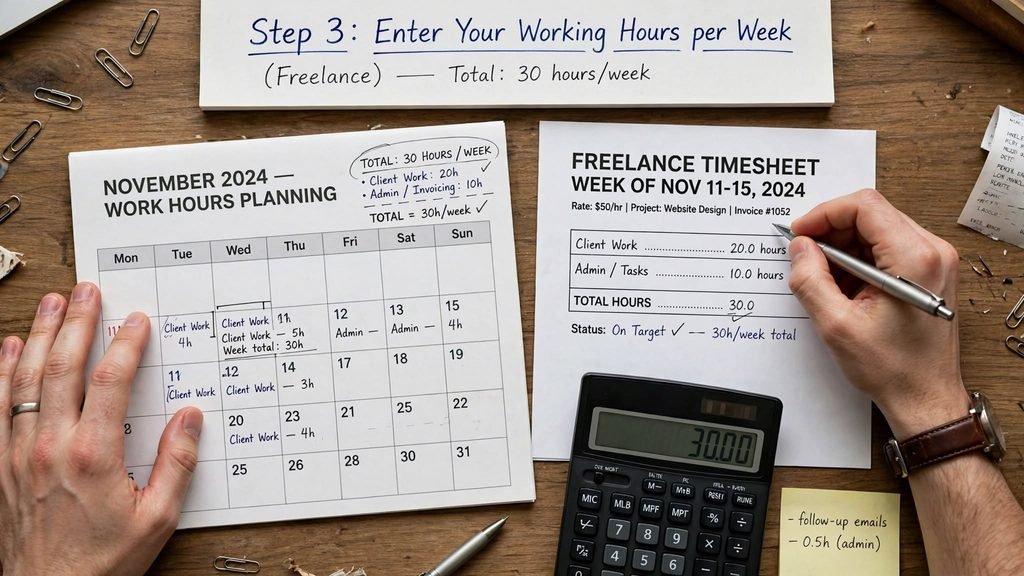
3. Enter Your Working Hours per Week
This field represents the total time you expect to work each week, including both client work and business administration.
For example, you might plan to work 30 hours per week. That does not mean you can bill clients for all 30 hours. Some of that time will probably be spent on marketing, scheduling, communication, invoicing, and other activities.
Choose a schedule you can maintain consistently rather than assuming you will work at maximum capacity every week.
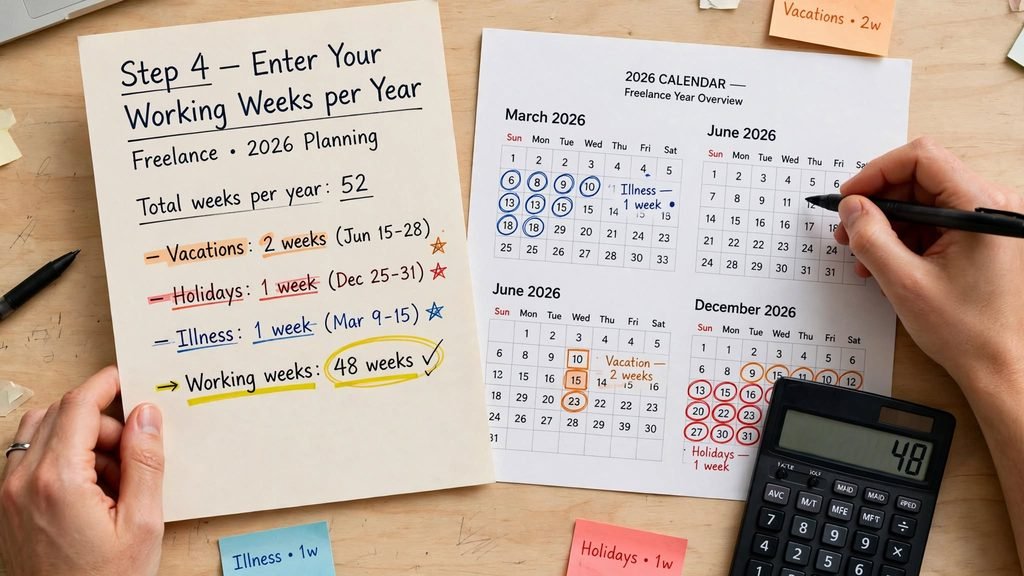
4. Enter Your Working Weeks per Year
No freelancer works every week of the year without interruption. Vacations, public holidays, illness, training, and quiet periods can reduce your available working time.
If you expect to take several weeks off during the year, reduce the number of working weeks accordingly. This helps prevent the calculator from overstating your annual billable capacity.
5. Estimate Your Billable Time Percentage
Billable time is the portion of your working hours that you can charge to clients.
Suppose you work 30 hours per week for 48 weeks per year. That gives you 1,440 total working hours. If 60% of those hours are billable, your estimated annual billable time is 864 hours.

The remaining hours are available for activities that support your business but do not generate direct hourly billing.
Your billable percentage depends on your service, client relationships, experience, and workload. Track your time for several weeks to develop a realistic estimate.
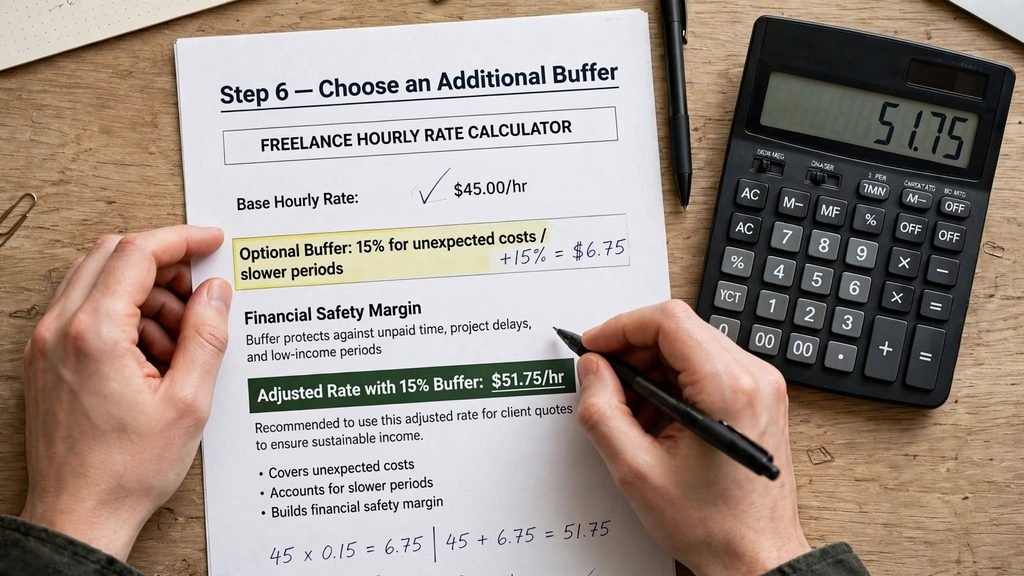
6. Choose an Additional Buffer
The optional buffer adds a percentage to your estimated annual revenue target. It can help you plan for unexpected business costs, slower periods, or fluctuations in demand.
A buffer is not a guarantee against losses, and it should not replace a proper expense estimate. Use a percentage that makes sense for your circumstances, and review it as your business develops.
Once all fields are completed, the freelance hourly rate calculator updates the suggested hourly rate and displays your estimated annual billable hours and revenue target.
How to Calculate Your Freelance Hourly Rate
You can estimate a freelance rate using the following formula:
Step 1: Calculate annual billable hours
Annual working hours = Weekly working hours × Working weeks per year
Annual billable hours = Annual working hours × Billable percentage
Step 2: Calculate your annual revenue target
Annual revenue target = (Target annual income + Annual business expenses) × (1 + Buffer percentage)
Step 3: Calculate the hourly rate
Hourly rate = Annual revenue target ÷ Annual billable hours
Example Calculation
Imagine a freelancer uses these estimates:
- Target annual income: $60,000
- Annual business expenses: $12,000
- Working hours per week: 30
- Working weeks per year: 48
- Billable time: 60%
- Additional buffer: 10%
First, calculate annual working hours:
30 × 48 = 1,440 hours
Next, calculate billable hours:
1,440 × 60% = 864 hours
Then, calculate the annual revenue target:
($60,000 + $12,000) × 1.10 = $79,200
Finally, divide the annual revenue target by billable hours:
$79,200 ÷ 864 = approximately $91.67 per hour.
In this example, the freelancer would need to bill approximately $91.67 per hour to meet the stated planning assumptions.
This is an estimate before personal taxes and does not establish whether clients in a particular market will accept that rate. You can change the calculator inputs to explore different schedules, expense levels, and income goals.
Why Freelancers Need to Account for Non-Billable Time
One of the most common pricing mistakes is dividing a desired income by every available working hour. This approach can underestimate the rate you need because not every hour produces billable revenue.
Non-billable activities can include:
- Finding and communicating with prospective clients
- Preparing quotes and proposals
- Marketing your services
- Managing projects and schedules
- Maintaining your website or portfolio
- Preparing invoices and organizing records
- Learning new skills and improving your services
These tasks support your business even when they do not appear as separate line items on a client invoice.
Using a realistic billable percentage in your freelance hourly rate calculator helps account for this time. If your business becomes more efficient or you gain recurring clients, you may be able to increase the proportion of time spent on paid work.
How to Choose a Competitive Freelance Rate
Your calculated rate is a starting point. Before publishing your prices or sending a quote, consider the following factors.
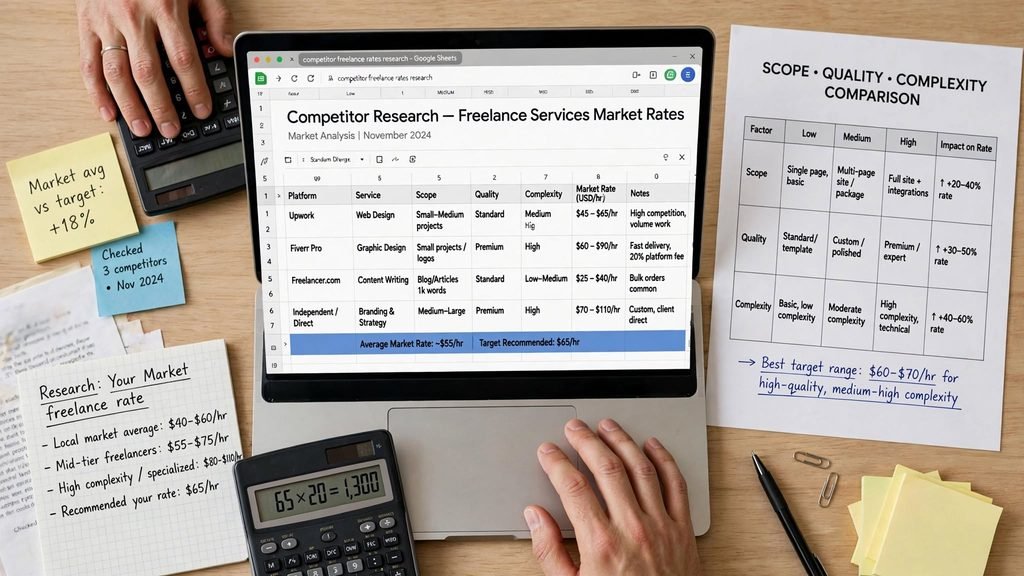
Research Your Market
Compare services similar to yours in scope, quality, and complexity. Look at the type of client served, the expected deliverables, and the experience required.
Avoid comparing your service with a different offering simply because both are described with the same job title. A small, straightforward task may require a different price from a complex project involving research, revisions, and specialist knowledge.

Consider Your Experience and Value
Specialized skills, a strong portfolio, dependable communication, and a record of successful projects can help distinguish your services.
Your price should reflect the work involved and the outcome you provide, not just the time needed to complete the task. Make sure your project scope and deliverables are clear before agreeing to a price.
Review Your Rate Regularly
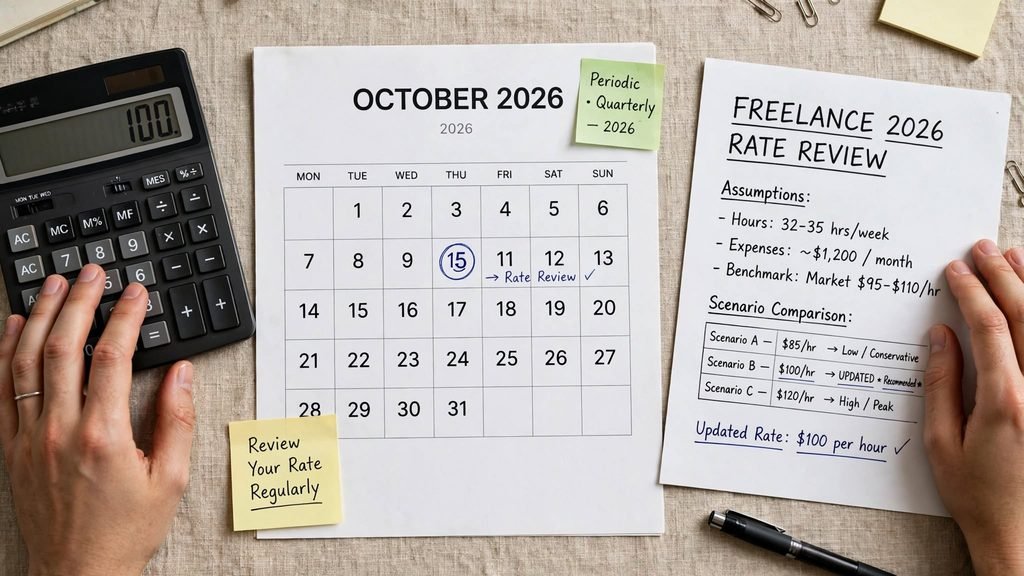
Business expenses, demand, skills, and available working hours can change. Review your pricing periodically and update your assumptions when needed.
The freelance hourly rate calculator can help you compare different scenarios. For example, you can see how a lower billable percentage or higher annual expenses affect the hourly rate required to meet your target.
Hourly Pricing vs. Project-Based Pricing
Hourly pricing charges clients for the billable time spent on a task. It can work well when the scope is flexible, the work is ongoing, or the amount of time required is uncertain.
Project-based pricing sets a price for a defined result or package of deliverables. It may suit projects with a clear scope, such as a website design, a set of articles, or a specific consulting assignment.
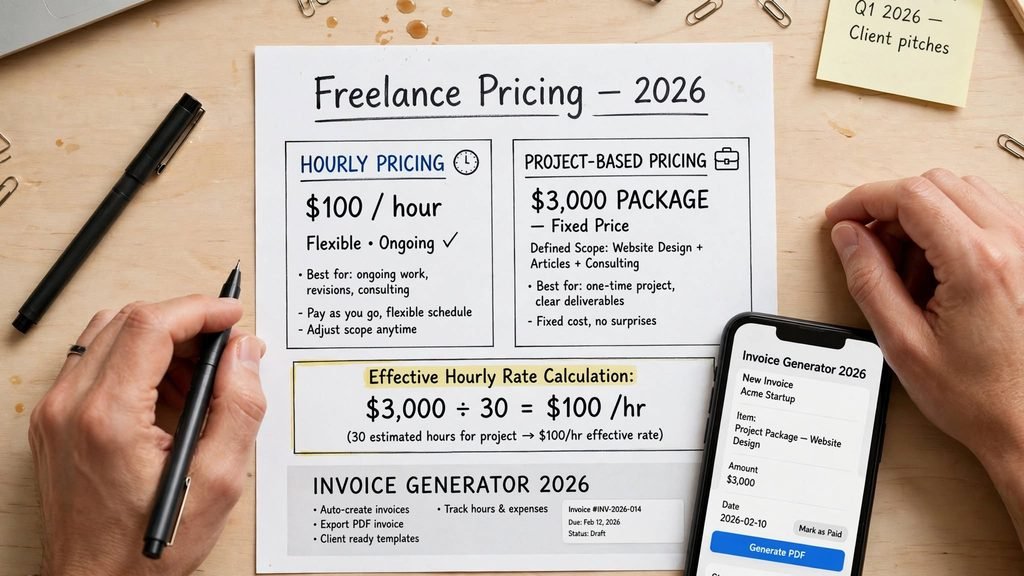
Even if you charge by the project, calculating your effective hourly rate can help you evaluate whether the price covers your time and business costs. Estimate the hours involved, include likely revisions and administration, and compare the result with your target rate.
You can use our Free Invoice Generator to prepare professional invoices for completed freelance work.
Organize Your Business Finances
Pricing decisions become easier when your records are accurate and your business costs are easy to identify.
Keep business receipts, invoices, contracts, and expense records organized. Our guide to Small Business Bookkeeping Basics for Beginners explains practical ways to maintain clear financial records.
You may also find these resources helpful:
- How to Separate Business and Personal Expenses
- Essential Records Every Small Business Should Keep
- Profit Margin Calculator
These tools and guides can help you understand your costs, keep records organized, and make more informed business decisions.
Freelancers in the United States should also review the IRS's official Self-Employed Individuals Tax Center to understand applicable tax responsibilities. The calculator above does not estimate individual tax obligations, so consider your tax situation separately.
Final Thoughts
Setting a freelance rate is about more than choosing a number that sounds competitive. You need to account for the income you want, the costs of operating your business, and the hours you can realistically bill.
Our freelance hourly rate calculator provides a practical starting point for those decisions. Enter your own estimates, compare different scenarios, and use the result alongside market research and a clear understanding of your services.
With accurate records, realistic assumptions, and regular reviews, you can build a pricing approach that better supports your freelance business over time.
Frequently Asked Questions
There is no single rate that works for every freelancer. A suitable rate depends on your income goal, business expenses, billable hours, experience, service type, and market. Use the calculator to estimate your required rate, then compare it with similar services.
Add your target annual income to your annual business expenses, apply any optional buffer, and divide the resulting revenue target by your estimated annual billable hours. The calculator performs these steps automatically.
Not necessarily. Some freelancers bill by the hour, while others charge per project or deliverable. However, your pricing should account for the time you spend running your business, even when that time is not billed directly to a client.
It depends on your business model and workload. Client-facing professionals with ongoing projects may have different billable patterns from freelancers who spend substantial time marketing, preparing proposals, or developing new services. Track your time to estimate a realistic percentage.
No. The calculator estimates a rate from your income goal, business expenses, billable time, and buffer. It does not calculate federal, state, or local taxes, or determine your personal tax liability. Review official tax guidance or consult a qualified tax professional for advice specific to your circumstances.
Choose the pricing structure that fits the work and the client's expectations. Hourly pricing can suit ongoing or changing work, while project pricing can work well when the deliverables and scope are clearly defined. Calculate your effective hourly earnings to evaluate whether a project price is sustainable.
Review it whenever your expenses, experience, demand, or working capacity changes, and consider a regular review at least once a year. Recalculate your target using realistic figures rather than relying on an outdated estimate.