
Last Updated: November 05, 2026
Knowing how efficiently your vehicle uses fuel can help you understand your driving expenses and make better transportation decisions. Whether you drive a compact car, SUV, pickup truck, or family vehicle, monitoring fuel economy is a practical way to evaluate your vehicle’s performance.
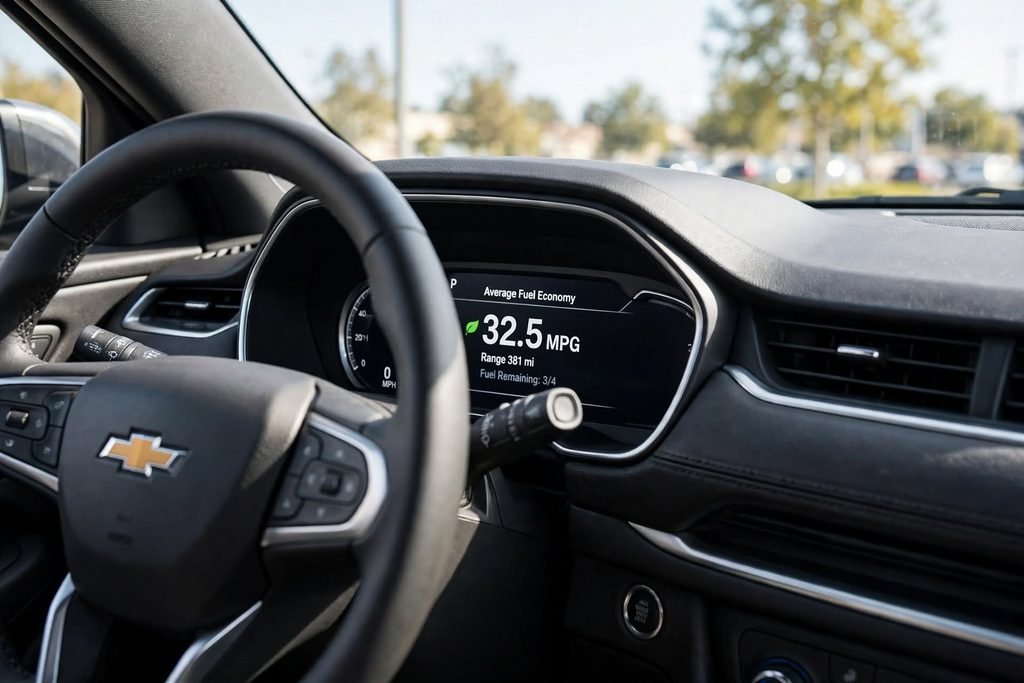
Our free MPG calculator makes it easy to calculate your vehicle’s miles per gallon using two simple measurements: the distance you have driven and the amount of fuel consumed. You can also use your starting and ending odometer readings to determine your actual driving distance.
Understanding your vehicle’s MPG can help you identify changes in fuel consumption, compare driving conditions, and monitor your vehicle’s performance over time. In this guide, you will learn how to calculate MPG, understand your results, and use practical methods to monitor your car’s fuel economy.
MPG Calculator
Calculate your vehicle’s fuel economy using miles driven and gallons of fuel consumed.
Your Fuel Economy Results
Results are estimates based on the values entered. Actual fuel economy may vary with driving conditions, vehicle maintenance, and measurement accuracy.
What Is MPG (Miles Per Gallon)?
MPG stands for miles per gallon. It is a standard measurement used in the United States to describe how far a vehicle can travel using one gallon of fuel.
For example, a vehicle that achieves 30 MPG can travel approximately 30 miles using one US gallon of gasoline under the measured driving conditions.
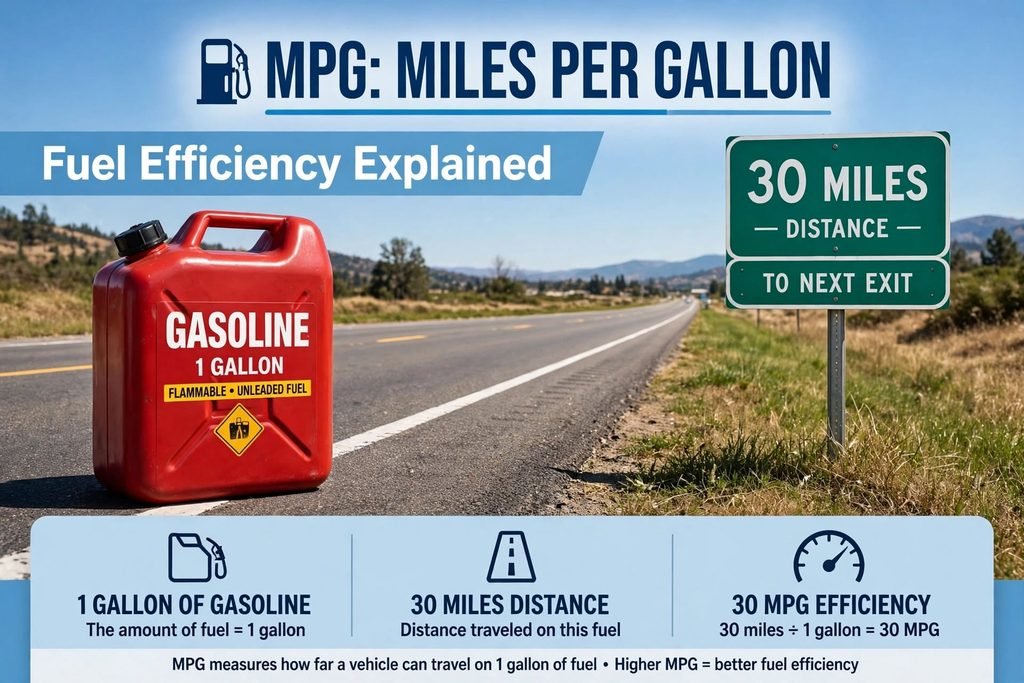
A higher MPG generally indicates better fuel efficiency because the vehicle travels farther using the same amount of fuel. Conversely, a lower MPG means the vehicle consumes more fuel to cover the same distance.
Understanding MPG is useful when evaluating vehicle performance, comparing different vehicles, and monitoring everyday fuel consumption.
The US Department of Energy uses miles per gallon as a standard measure of conventional vehicle fuel economy. You can explore official vehicle information through FuelEconomy.gov.
How to Use Our MPG Calculator
Our MPG calculator is designed to make fuel economy calculations straightforward. You do not need advanced automotive knowledge or complicated mathematical formulas.
Follow these steps:
- Choose a calculation method: Select Distance & Gallons if you already know how many miles you drove and how much fuel you consumed. Alternatively, select Odometer Readings if you have recorded your vehicle’s starting and ending mileage.
- Enter the distance driven: Provide the total number of miles traveled during the measurement period. Make sure you use miles rather than kilometers.
- Enter the fuel consumed: Enter the total number of US gallons used to cover that distance.
- Calculate your MPG: Click the Calculate MPG button to process your information.
- Review your results: The calculator displays your miles per gallon, gallons per 100 miles, and estimated fuel needed to travel 1,000 miles.
You can reset the calculator and enter new measurements whenever you want to evaluate another trip or measurement period.
For more detailed information about your vehicle’s fuel expenses, you can also use our Gas Cost Calculator.
MPG Calculator Formula: How to Calculate Miles Per Gallon
Calculating miles per gallon requires only two values: the total distance traveled and the total amount of fuel consumed.
The standard MPG formula is:
MPG = Total Miles Driven ÷ Gallons of Fuel Used
For example, suppose your vehicle travels 360 miles and consumes 12 gallons of gasoline.
The calculation is:
MPG = 360 ÷ 12
MPG = 30
This means your vehicle achieved 30 miles per gallon during the measured period.
The same formula can be used for cars, SUVs, pickup trucks, and other gasoline-powered vehicles, provided the distance and fuel measurements are accurate and expressed in compatible units.
Understanding the Additional Fuel Economy Measurements
Our MPG calculator also provides two additional measurements.
1. Gallons per 100 Miles
This measurement shows how many gallons your vehicle consumes to travel 100 miles.
Formula:
Gallons per 100 Miles = (Gallons Used ÷ Miles Driven) × 100
For a vehicle achieving 30 MPG:
(12 ÷ 360) × 100 = 3.33 gallons
Therefore, the vehicle uses approximately 3.33 gallons for every 100 miles traveled.
2. Estimated Fuel for 1,000 Miles
This measurement estimates the amount of fuel required to travel 1,000 miles at the same average fuel economy.
Formula:
Fuel for 1,000 Miles = 1,000 ÷ MPG
For a vehicle achieving 30 MPG:
1,000 ÷ 30 = 33.33 gallons
The estimated fuel requirement is approximately 33.33 gallons.
These measurements help drivers understand fuel consumption from different perspectives.
How to Calculate MPG Using Your Odometer Readings
If you do not know the exact distance traveled, you can calculate it using your vehicle’s odometer.
The odometer records the cumulative distance covered by your vehicle.
To calculate MPG using this method, you need three values:
- Starting odometer reading.
- Ending odometer reading.
- Total gallons of fuel consumed.
First, calculate the distance:
Distance Driven = Ending Odometer Reading − Starting Odometer Reading
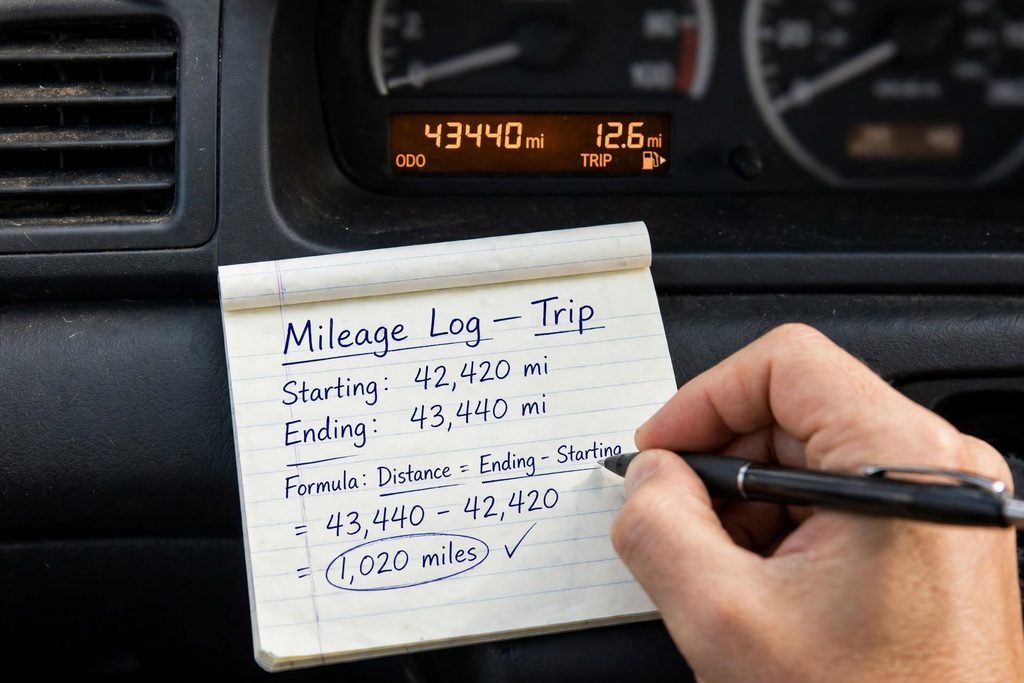
For example:
Starting reading: 45,200 miles
Ending reading: 45,500 miles
Distance = 45,500 − 45,200 = 300 miles
If the vehicle consumed 10 gallons during this period:
MPG = 300 ÷ 10
MPG = 30
This method is particularly useful for drivers who want to monitor their actual fuel economy over several refueling periods.
For better accuracy, record your mileage and fuel consumption consistently, preferably using the same refueling procedure each time.
What Is a Good MPG for a Car?
A good MPG depends on several factors, including vehicle size, engine type, vehicle age, driving conditions, and intended use.
Small passenger cars generally achieve different fuel economy figures from larger SUVs and pickup trucks.

For example, consider these hypothetical fuel economy figures:
| Vehicle Type | Example MPG |
|---|---|
| Small compact car | 35 MPG |
| Midsize sedan | 30 MPG |
| Midsize SUV | 25 MPG |
| Large SUV | 20 MPG |
| Pickup truck | 18 MPG |
These numbers are illustrative examples, not official average ratings or guaranteed performance figures.
When evaluating a vehicle, compare its actual MPG with the official EPA estimates for the exact make, model, engine, and model year.
You can use FuelEconomy.gov to research official fuel economy information for different vehicles.
Remember that a vehicle’s actual fuel economy may differ from its official rating because real-world driving conditions are not always identical to standardized testing conditions.
Factors That Affect Your Vehicle’s MPG
Several factors can influence how much fuel your vehicle consumes. Understanding them can help you interpret your MPG calculator results more accurately.
1. Driving Speed
Driving at excessive speeds can increase fuel consumption because aerodynamic resistance becomes more significant as speed increases.
Maintaining a reasonable and consistent speed can help improve fuel efficiency.
2. Rapid Acceleration and Hard Braking
Frequent acceleration and sudden braking can reduce fuel economy, particularly in heavy traffic.
Smooth acceleration and anticipating traffic conditions may help reduce unnecessary fuel consumption.
3. Vehicle Maintenance
Proper vehicle maintenance plays an important role in fuel efficiency.
Problems such as underinflated tires, worn components, and neglected engine maintenance can affect vehicle performance.
Follow your manufacturer’s maintenance recommendations and check tire pressure regularly.
4. Traffic and Driving Conditions
Stop-and-go traffic, frequent short trips, road gradients, and extended idling can influence fuel consumption.
A vehicle may achieve different MPG figures when driving in urban areas compared with relatively uninterrupted highway driving.
5. Vehicle Weight and Cargo
Carrying unnecessary cargo increases the weight your vehicle must move.
Removing unused heavy items and avoiding unnecessary loads can help reduce fuel consumption.
6. Weather and Temperature
Cold weather, extreme temperatures, and the use of heating or air conditioning can influence fuel economy.
The effect varies depending on the vehicle, journey length, and environmental conditions.
Practical Tips to Monitor and Improve Fuel Economy
Monitoring your MPG regularly can help you recognize changes in fuel consumption and understand your vehicle’s performance.
Here are some practical habits:
- Check tire pressure according to the manufacturer’s recommended specifications.
- Avoid unnecessary acceleration and sudden braking.
- Remove unnecessary cargo from your vehicle.
- Follow the recommended maintenance schedule.
- Avoid excessive idling whenever practical.
- Combine short errands when possible.
- Compare fuel economy across different driving conditions.
- Record fuel purchases and odometer readings consistently.
One useful approach is to calculate your MPG over several consecutive refueling periods rather than relying on a single short trip.
This provides a more representative picture of your vehicle’s average fuel economy.
If your MPG decreases unexpectedly and remains lower than usual, consider checking your vehicle’s condition and consulting a qualified automotive technician.
You can also read our guide on Essential Car Maintenance Tasks Every Driver Should Know for additional information about maintaining your vehicle.
Why Is Tracking MPG Important?
Tracking fuel economy provides useful information about your vehicle’s everyday performance.
First, it helps you understand how efficiently your vehicle uses gasoline. Instead of relying only on dashboard estimates, you can calculate MPG using your actual mileage and fuel consumption.
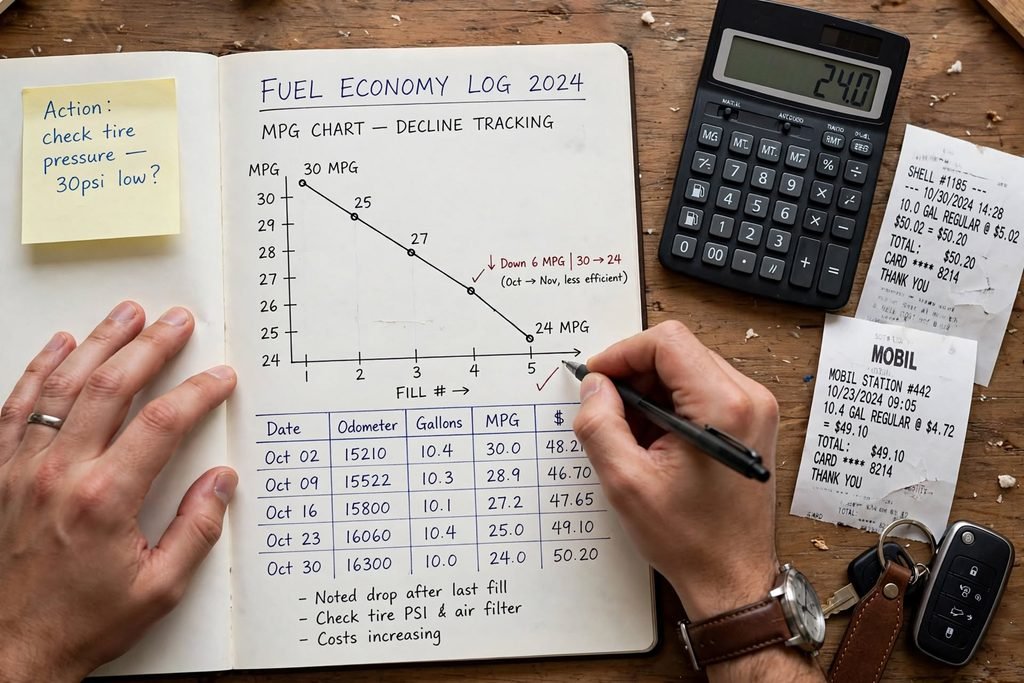
Second, monitoring MPG helps identify changes over time. If your vehicle previously achieved 30 MPG but now consistently achieves 24 MPG under similar conditions, further investigation may be useful.
Third, MPG measurements make it easier to compare vehicles. When considering a different car, comparing fuel economy ratings can help you understand potential differences in fuel consumption.
Finally, recording your fuel economy provides a practical way to evaluate the effects of driving habits and vehicle maintenance.
For additional guidance on reducing fuel consumption, explore our upcoming guide, How to Improve Gas Mileage and Save Money.
MPG Calculator vs. Gas Cost Calculator: What’s the Difference?
Although both tools relate to vehicle fuel consumption, they answer different questions.
An MPG calculator measures fuel efficiency by determining how many miles your vehicle travels per gallon.
A gas cost calculator estimates the amount of money required to purchase fuel for a particular journey.
For example, knowing that your vehicle achieves 30 MPG tells you how efficiently it uses gasoline. However, calculating the cost of a 300-mile journey also requires the fuel price per gallon.
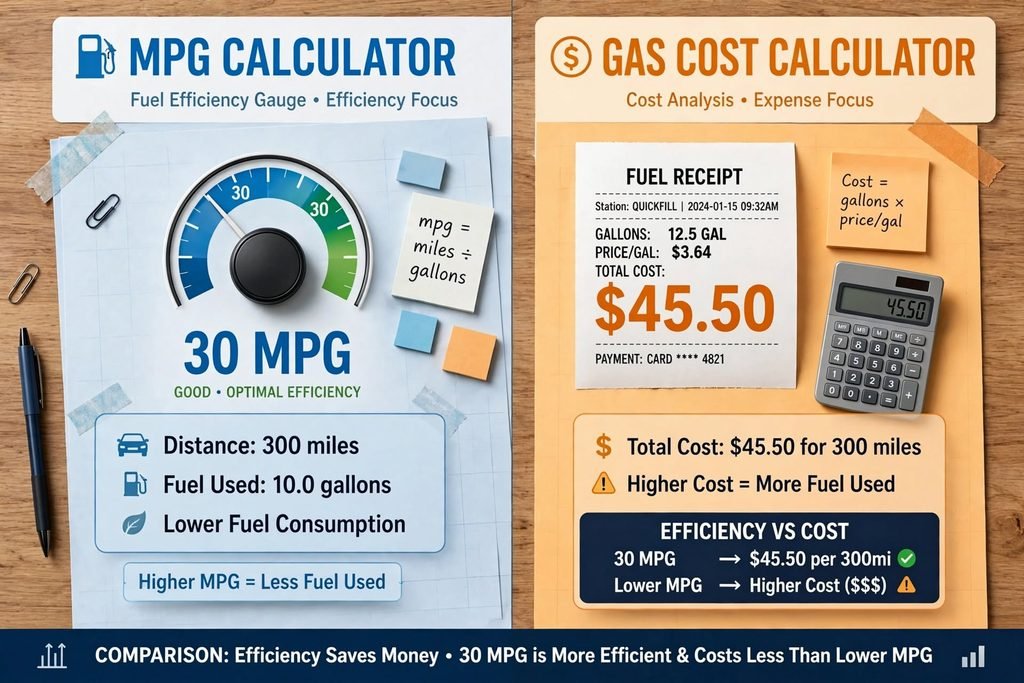
These tools complement each other and provide different information for understanding vehicle fuel consumption and transportation expenses.
You can use our Gas Cost Calculator to estimate the fuel expenses associated with your next trip.
If you also want to plan future vehicle servicing expenses, visit our Car Maintenance Cost Calculator.
Conclusion
Understanding your vehicle’s fuel economy is an important part of responsible vehicle ownership. By monitoring miles per gallon, you can evaluate fuel consumption, identify changes in performance, and make more informed transportation decisions.
Our free MPG calculator provides a simple way to calculate fuel efficiency using actual driving distance and fuel consumption. Whether you use direct mileage measurements or odometer readings, the calculator helps you understand your vehicle’s fuel economy in seconds.
For a more complete approach to managing vehicle expenses, explore our other Cars & Transportation calculators and practical automotive guides at AffordablyUSA.
Frequently Asked Questions
MPG means miles per gallon. It measures how many miles a vehicle can travel using one gallon of fuel. A higher MPG generally indicates better fuel efficiency.
Divide the total number of miles driven by the total gallons of fuel consumed. For example, driving 300 miles using 10 gallons gives you 30 MPG.
A good MPG depends on vehicle type, engine characteristics, model year, and driving conditions. Compare your results with official EPA fuel economy ratings for your specific vehicle.
Yes. Subtract the starting odometer reading from the ending reading to determine the distance traveled. Then divide that distance by the gallons consumed.
Generally, yes. A higher MPG means that a vehicle can travel more miles using the same quantity of fuel, indicating better fuel efficiency.
MPG measures the distance traveled per gallon, while gallons per 100 miles measures the amount of fuel required to travel 100 miles. MPG increases as fuel efficiency improves, whereas gallons per 100 miles decreases.
Fuel economy can change because of driving speed, traffic, weather, tire pressure, vehicle maintenance, cargo weight, and other operating conditions.
You can calculate MPG after each complete refueling measurement period or regularly over several weeks. Consistent measurements provide a better understanding of your vehicle’s average fuel economy.
Yes. The MPG calculator works for gasoline-powered cars, SUVs, pickup trucks, and other vehicles when you enter the correct distance and fuel consumption values.
Yes. The AffordablyUSA MPG calculator is free to use. You can enter your vehicle measurements and calculate fuel economy without creating an account.